DC Medicaid’s Gainwell Transition Is Bigger Than a Vendor Change
A lot of providers in Washington, DC are feeling the pressure right now, and honestly, it makes sense.
What looks on paper like a routine fiscal agent transition has become a major operational shift for organizations that rely on timely Medicaid billing to keep services running.
As of March 2, 2026, DC Medicaid transitioned fiscal agent services to Gainwell and moved providers into a new claims environment. Before submitting live fee-for-service claims, providers, billing agents, and clearinghouses were required to register in the new portal, complete setup steps, and in many cases complete EDI testing and certification. DC Medicaid also stated that claims submitted without completed registration and testing could be rejected, leading to payment delays.
For providers, especially behavioral health agencies, home health organizations, direct care employers, and multi-site practices, this is not just a billing-office inconvenience. It affects cash flow, payroll planning, staff morale, and the ability to keep operations steady.
What Changed Under the New Gainwell Process?
DC Medicaid’s transition introduced several new operational requirements.
Providers now need to:
- register in the new DC Medicaid portal,
- designate an office or primary administrator,
- complete identity verification and MFA,
- add users and assign roles,
- associate billing agents where applicable,
- use the new Gainwell Trading Partner ID,
- and complete required EDI testing and certification for electronic claims submission.
DC Medicaid also made it clear that all electronic claims after go-live must be submitted through the new portal environment, and paper claims and appeals must now go to Gainwell.
For many organizations, that means the transition is not just technical. It changes internal workflows, staff responsibilities, communication with billing agents, and claim submission habits.
Why Providers Are Struggling
The challenge is not only that the system changed. It is that several changes happened at once.
First, the registration and testing requirements are not optional. DC Medicaid explicitly required registration and EDI testing for billing providers, billing agents, clearinghouses, and others who submit or process DC Medicaid claims, regardless of how they submitted claims before. Providers were warned that failure to complete the required process could result in claim rejection and nonpayment.
Second, there was a hard transition window. DC Medicaid stated that February 20, 2026 was the last day to send electronic claims to Conduent, and that providers should not submit claims from February 21 through March 1, 2026 during the transition period.
Third, the transition came with billing rule enforcement changes. For example, DC Medicaid said home health agencies must use Type of Bill 32X for state plan home health services effective March 2, 2026, and that claims submitted with the wrong TOB code would be denied in the EDI gateway. DC Medicaid also issued updated paper billing instructions, including UB-04 payer-field requirements and confirmation that Gainwell would process paper claims received under the new rules beginning March 2.
So when providers say, “Billing has gotten harder,” they are not exaggerating. The burden is now spread across billing, credentialing, staff setup, internal controls, and training.
How This Disrupts Real Operations
When billing gets interrupted, the effect is rarely isolated to the finance department.
For many providers, the real problems look like this:
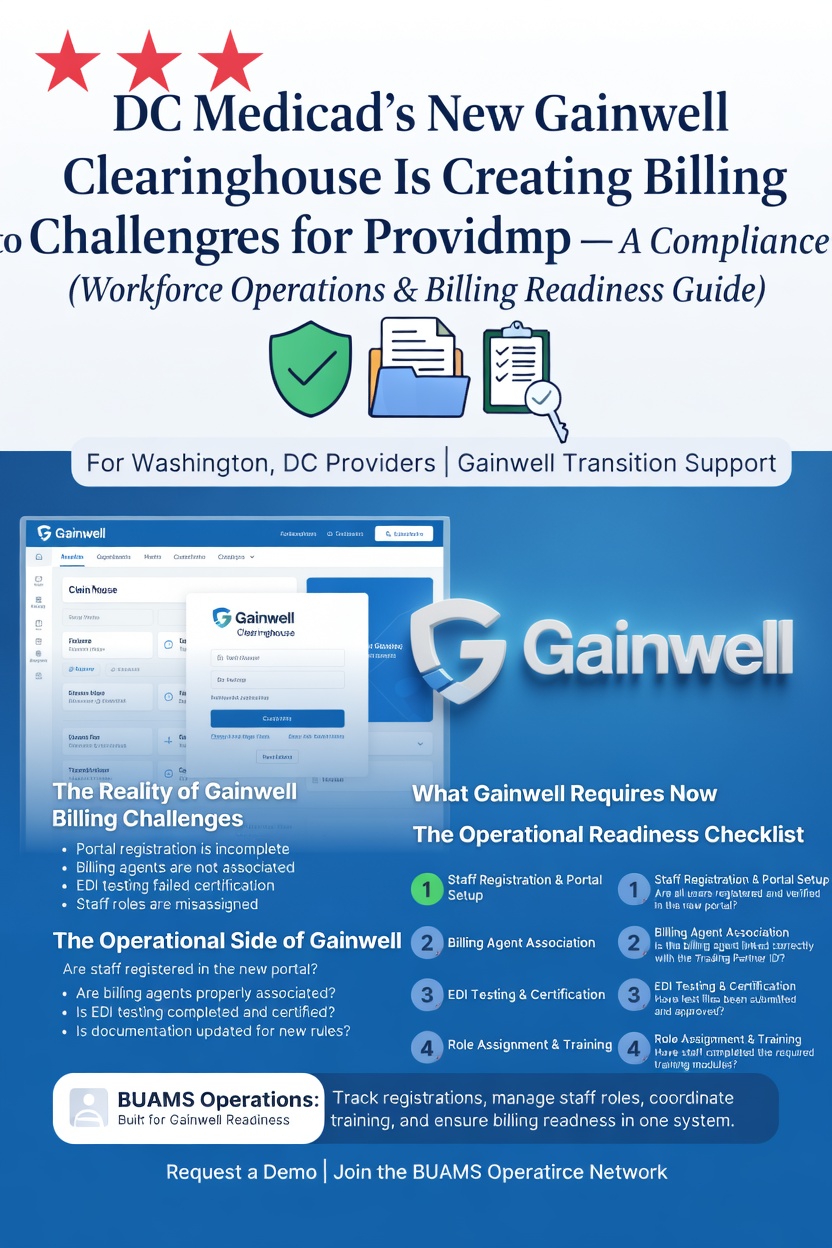
- claims are held up because portal registration is incomplete,
- users do not have the right roles,
- billing agents are not fully associated,
- EDI files fail testing,
- staff are unsure which workflow changed,
- claim corrections slow down,
- and leadership has no single place to track readiness.
These pain points are a direct and predictable result of the new DC Medicaid requirements around portal registration, trading partner setup, user roles, certification, and updated billing instructions.
For behavioral health providers, the impact can be especially stressful. When revenue slows, everything else tightens: payroll, hiring, onboarding, supervision capacity, and the ability to grow programs.
The Most Common Breakdown Points
Based on the transition guidance DC Medicaid and Gainwell published, the biggest risk areas appear to be:
1. Registration is incomplete
Providers were told to preregister in the live portal and complete setup steps using NPI, TIN, PIN letter, and user verification. If that setup is incomplete, billing cannot move smoothly.
2. Billing agents and providers are not aligned
DC Medicaid specifically instructed providers to associate billing agents and instructed billing agents to use only their own Trading Partner ID for certification. If the provider side and billing-agent side are not coordinated, submission failures become much more likely.
3. Testing was treated like a formality
The state required three test files per file type, with at least 15 claims per file, and separate testing for professional, institutional, and dental claims as applicable. That is a serious operational task, not a quick checkbox.
4. Internal billing rules were not updated
DC Medicaid also published specific billing changes and paper-form updates. If an organization keeps using legacy habits or outdated billing assumptions, denials increase.
5. Training did not reach the right people
DC Medicaid strongly encouraged organizations to ensure that the people involved in Medicaid billing attend training sessions, and it made training resources, LMS access, manuals, companion guides, and FAQs available through the new environment.
What Providers Should Do Right Now
If your organization is still feeling the impact of the Gainwell transition, the solution is not panic. It is structure.
A practical recovery plan looks like this:
Confirm portal readiness
Verify that the organization is fully registered in the DC Medicaid portal, that the correct administrator is in place, and that all necessary internal users have been added with the right roles.
Validate billing-agent relationships
If you use an outside billing company or clearinghouse, confirm both sides have completed the required association and are using the correct Trading Partner ID workflow.
Recheck claim specifications
Review the companion guides, billing manuals, and transition bulletins, especially for any service lines affected by new billing rules or stricter enforcement. Home health providers in particular need to verify TOB usage.
Train both billing and operations staff
This is not just a revenue-cycle issue. Supervisors, compliance staff, credentialing teams, and operations leads should understand what changed, who owns what, and where problems are likely to occur. DC Medicaid published training pathways and LMS access instructions for providers.
Build a claims-readiness workflow
Organizations need a simple internal dashboard: registration status, user role completion, billing-agent association, testing completion, denial patterns, and escalation contacts.
That is the part many providers are still missing.
Where BUAMS Fits In
To be transparent, BUAMS is not the DC Medicaid MMIS and it does not replace Gainwell’s portal.
What BUAMS does solve is the internal operational mess that makes transitions like this painful.
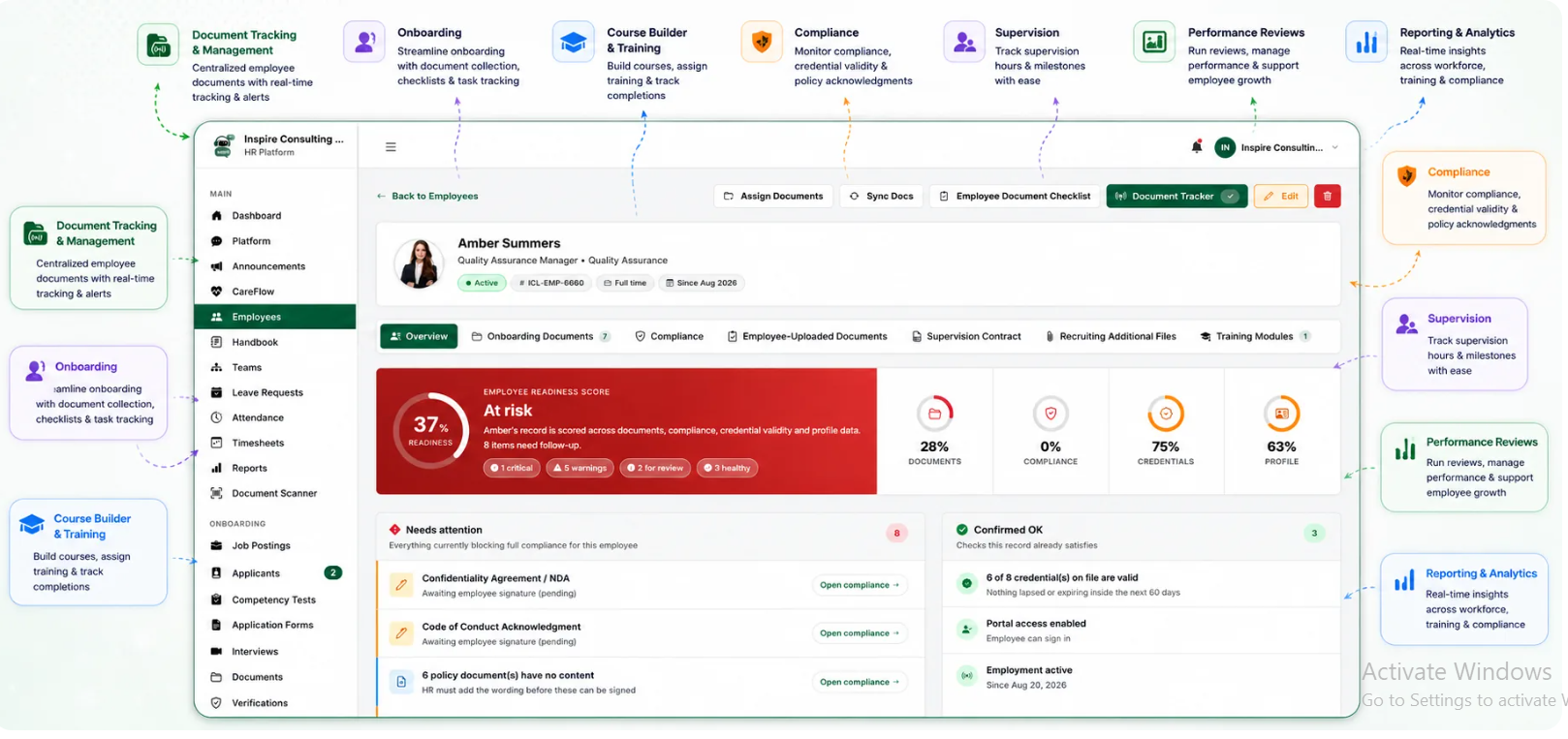
BUAMS helps providers organize the people, tasks, accountability, and compliance steps around billing readiness. That matters because most claim disruptions are not caused by one bad claim. They are caused by scattered workflows, missing follow-up, unclear ownership, incomplete staff setup, and weak coordination across billing, HR, compliance, and leadership.
With BUAMS, organizations can create a more controlled process around:
- staff role assignment and accountability,
- onboarding and training completion,
- supervision and follow-up,
- credential and compliance tracking,
- task management across departments,
- and operational visibility for leadership.
In practical terms, that means BUAMS can help your organization answer questions like:
- Has the right person completed portal setup?
- Did the billing lead attend Gainwell training?
- Was the billing agent association completed?
- Which staff still have open readiness tasks?
- Where are our delays happening?
- Who is responsible for resolution?
That is where many providers need help right now—not just with billing itself, but with the organizational workflow surrounding billing.
Why This Matters for Behavioral Health and Direct Care Providers
Behavioral health and direct care organizations are especially vulnerable during billing transitions because margins are often tight and staffing demands are already high.
A delayed claims cycle does not stay in the billing department. It spills into:
- hiring delays,
- slower onboarding,
- payroll pressure,
- supervision disruptions,
- training gaps,
- and leadership stress.
That is why providers need more than a billing vendor. They need a system for managing operational readiness across the whole organization.
That is the gap BUAMS is built to fill.
Final Thoughts
The new Gainwell clearinghouse process in DC is creating real pressure because it added several requirements at once: portal registration, role configuration, billing-agent association, testing, certification, and billing-rule updates. DC Medicaid’s own transition notices make clear that missing those steps can lead to rejected claims and payment delays.
The providers who will stabilize fastest are the ones who stop treating this as only a billing problem.
It is a workforce, training, accountability, and operational workflow problem too.
And that is exactly where BUAMS can help.
Call to Action
If your organization is struggling with the Gainwell transition, BUAMS (Inspire Consulting) can help you bring structure to the chaos.
Go to: https://calendly.com/inspirec/consulting?month=2026-03
Request a demo to see how BUAMS supports workforce accountability, training coordination, compliance tracking, and operational readiness for healthcare providers in DC.
https://calendly.com/inspirec/consulting?month=2026-03