Accreditation Isn’t the Problem — The System Is
Most behavioral health organizations don’t fail accreditation because they don’t care about quality.
They fail because their systems are not built to sustain compliance.
If you’ve gone through CARF, Joint Commission, or state recertification, you’ve probably seen this firsthand:
- Everything looks fine day-to-day
- Then audit preparation starts
- And suddenly gaps appear everywhere
Missing documents.
Incomplete staff files.
Inconsistent supervision.
Training that was done—but not recorded.
The issue isn’t effort. It’s structure.
What Accreditation Actually Requires (Beyond Policies)
Accreditation standards are often misunderstood.
They are not just asking:
“Do you have policies?”
They are asking:
- Can you prove your staff are qualified?
- Can you show consistent supervision?
- Can you demonstrate ongoing training?
- Can you track outcomes and performance?
- Can you produce documentation immediately?
In other words:
Accreditation is a test of your operational system, not just your paperwork.
Where Most Organizations Break Down
Across PRP, OMHC, IOP, SUD, and direct care programs, the same issues show up repeatedly.
1. Staff Files Are Incomplete or Scattered
- credentials stored in different places
- missing documents
- expired background checks
Everything exists—but not in one place.
2. Supervision Is Inconsistent or Undocumented
- supervision happens informally
- no structured logs
- no tracking of frequency or quality
From an audit perspective, this looks like supervision is not happening.
3. Training Is Not Tracked Properly
- onboarding is done verbally
- ongoing training is not documented
- no clear competency records
This creates risk around staff readiness and quality of care.
4. Compliance Is Reactive Instead of Continuous
- teams prepare only when audits are coming
- documentation is rushed
- gaps are patched instead of fixed
This leads to burnout and repeated findings.
5. No Central Visibility for Leadership
- leadership cannot see compliance gaps in real time
- no dashboards or tracking
- issues surface too late
This is one of the biggest hidden risks.
The Real Cost of These Gaps
When these issues exist, the consequences are serious:
- failed or delayed accreditation
- corrective action plans
- recoupment risk
- reputational damage
- staff burnout
And most importantly:
it slows down your ability to grow.
What Actually Fixes the Problem
Fixing accreditation challenges is not about working harder.
It’s about building a system that makes compliance part of daily operations.
1. Centralize Workforce and Compliance
Everything related to staff—credentials, training, supervision—should be in one place.
2. Structure Supervision
- define frequency
- document consistently
- track performance
Supervision should be visible—not assumed.
3. Track Training and Competency
- assign training
- monitor completion
- document competency
This turns training into proof, not just activity.
4. Create Real-Time Visibility
Leadership should be able to see:
- compliance gaps
- staff status
- training completion
- supervision activity
At any time.
5. Shift from Event-Based to Continuous Compliance
Accreditation should not feel like an event.
It should feel like:
- something you are always ready for
- something built into your system
Why Spreadsheets and Manual Systems No Longer Work
Many organizations still rely on:
- Excel trackers
- shared folders
- email follow-ups
These tools may work at a small scale—but they break quickly as organizations grow.
They create:
- duplication
- inconsistency
- missed deadlines
- lack of accountability
And during audits, those gaps become visible immediately.
Where BUAMS HR Fits In
BUAMS HR was designed to solve exactly these challenges.
Not as a generic HR tool—but as a workforce and compliance system for healthcare organizations.
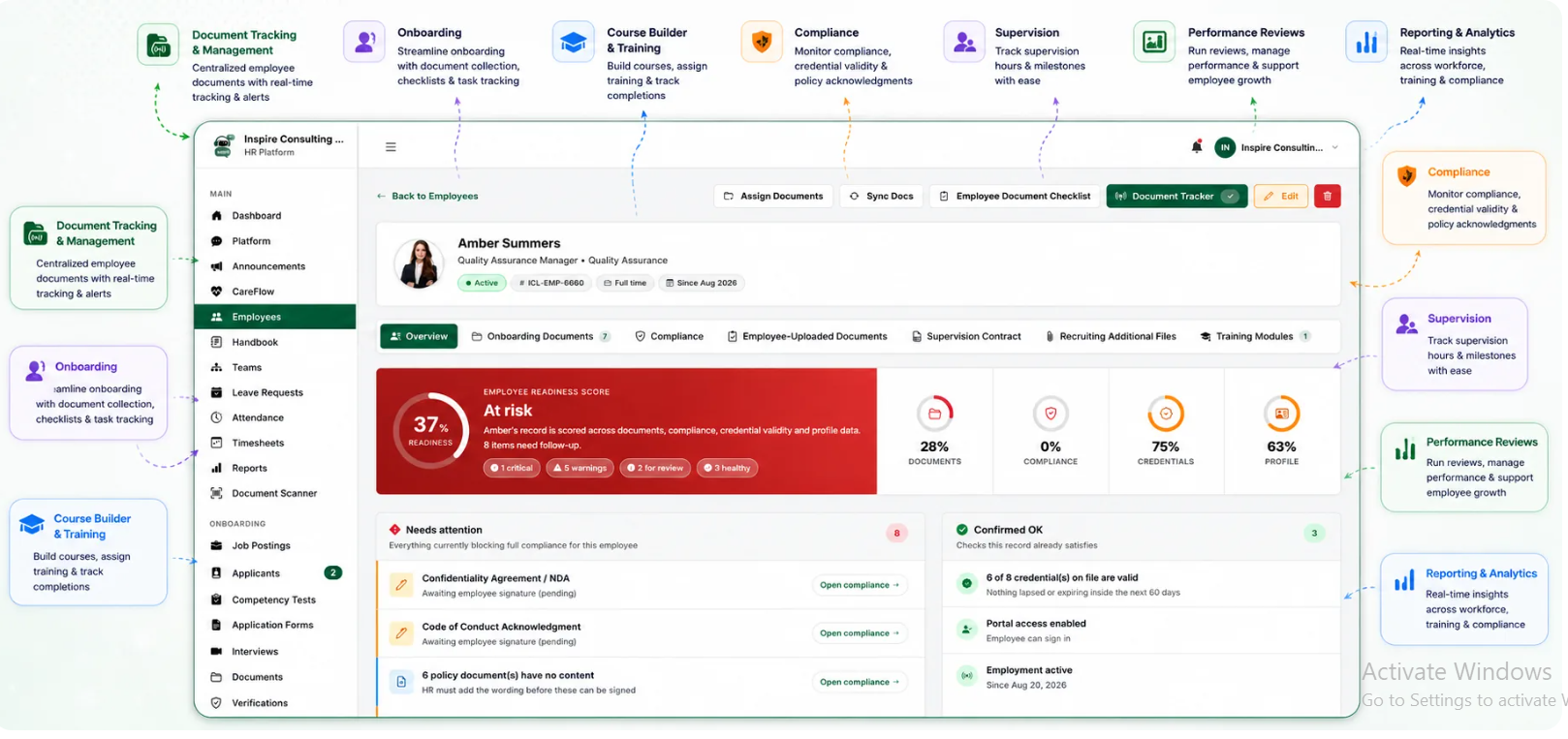
With BUAMS HR, organizations can:
- track staff credentials and expirations in one place
- document and monitor supervision consistently
- assign and track training across teams
- maintain structured staff records
- gain real-time visibility into compliance status
Instead of reacting to audits, you operate in a state of readiness.
What Changes When the System Is Right
When organizations implement structure:
- audits become predictable
- compliance becomes manageable
- staff accountability improves
- leadership gains clarity
- growth becomes easier
And most importantly:
your team spends less time scrambling and more time focusing on care.
Final Thoughts
Accreditation is not designed to make your life harder.
It’s designed to ensure quality, safety, and accountability.
But without the right systems, it becomes overwhelming.
The organizations that succeed are not necessarily the biggest or most experienced.
They are the ones that:
- build structure early
- stay consistent
- and invest in systems that support compliance
Call to Action
If your organization is preparing for accreditation—or trying to stay ahead of it:
Request a demo of BUAMS HR and see how you can bring structure to workforce management, supervision, and compliance.
Or, if you’re building your team:
Join the BUAMS workforce network and connect with qualified healthcare professionals