Behavioral health HR teams often know there is compliance risk in the workforce, but they do not always have a fast way to rank it. One employee may be missing a required attestation, another may be close to a license renewal deadline, and a third may be ready to start but still lacks one document needed for site assignment. When those issues are spread across email threads, spreadsheets, and separate employee files, leaders spend more time sorting the backlog than fixing it.
Employee compliance scorecard software gives providers a clearer way to organize that work. Instead of treating every missing item as equally urgent, HR and operations teams can see which gaps matter most, which employees need follow-up first, and where workforce risk is building across programs. That helps organizations act sooner, reduce last-minute scrambling, and keep staffing decisions grounded in current evidence.
Key Takeaways
What Is Employee Compliance Scorecard Software?
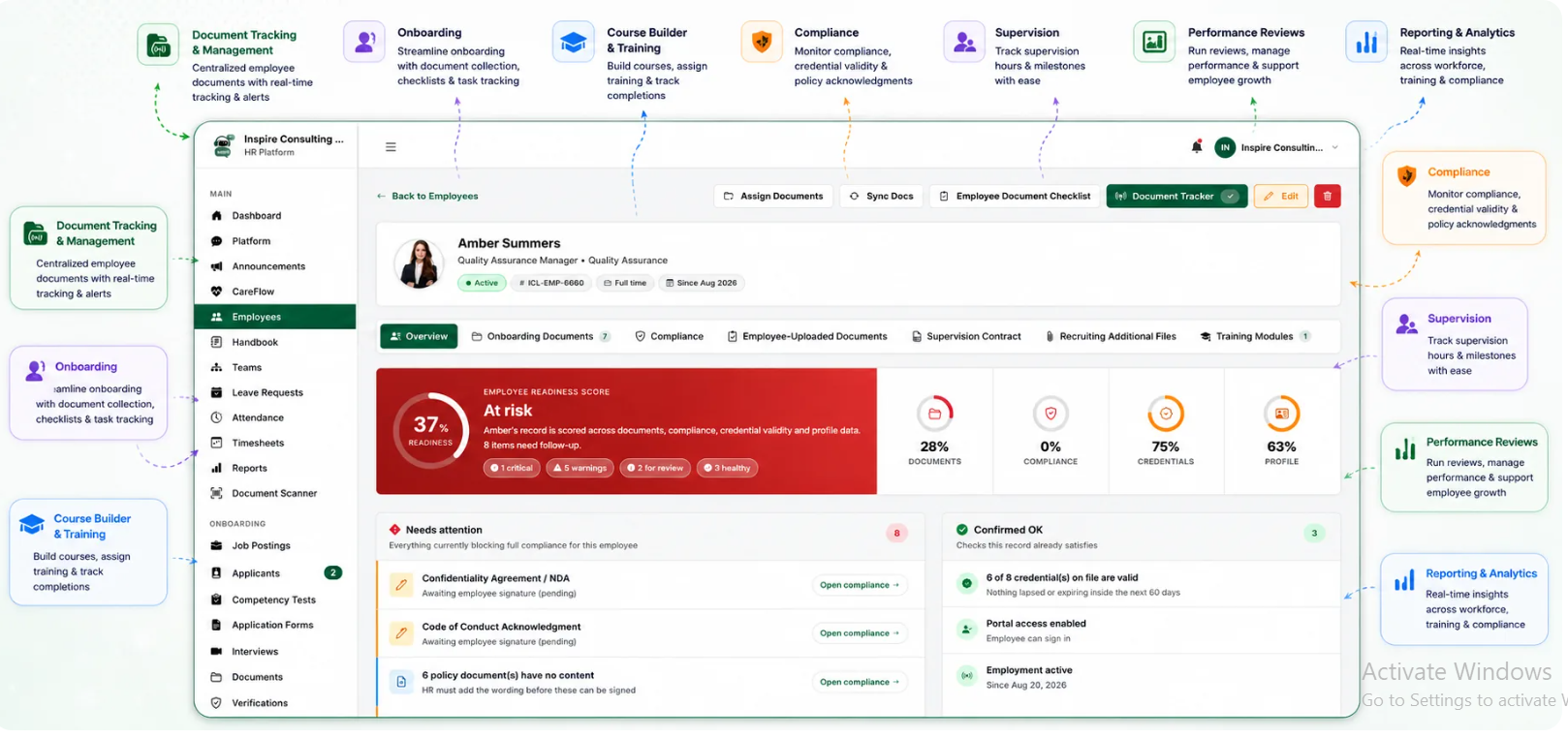
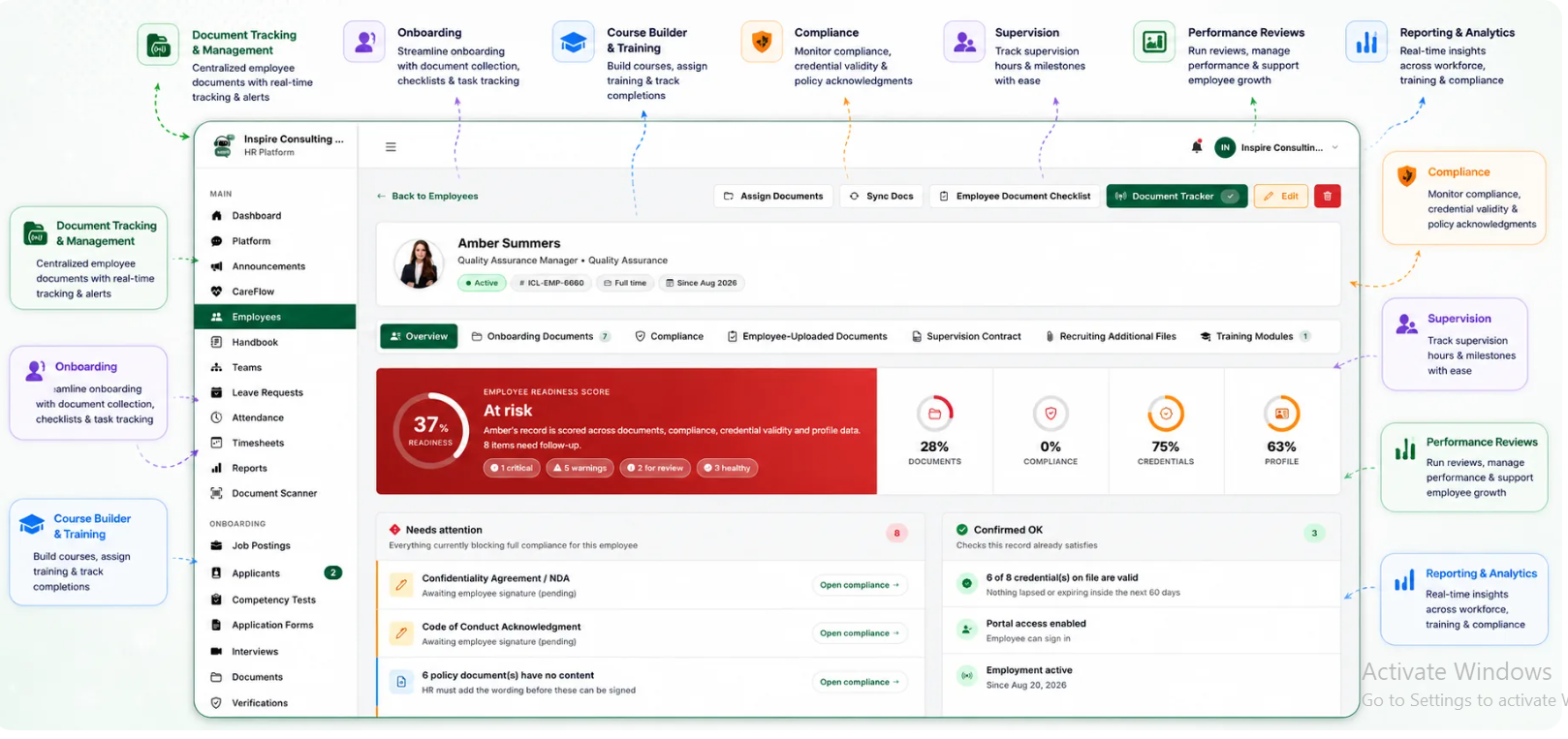
Employee compliance scorecard software is a system that summarizes workforce readiness indicators into a practical review format. Instead of making HR staff open each employee file one by one, the software brings together missing documents, expiring credentials, overdue training, required acknowledgments, supervision-related tasks, and other status signals that affect readiness.
In behavioral health, a scorecard is useful because compliance is rarely limited to one category. Start-date readiness, clinical oversight, annual training, health documentation, file completeness, and role-specific requirements can all affect whether an employee is ready for assignment. A strong scorecard system helps leaders see that full picture without rebuilding it manually every week.
The goal is not to reduce people to a generic number. The goal is to create a decision-ready view that shows where action is needed, why it matters, and who should respond next.
Why It Matters for Behavioral Health Providers
Behavioral health organizations operate with complex staffing models, multiple service lines, and frequent deadlines tied to workforce documentation. A provider may have employees at different sites, in different roles, and under different supervision or training expectations. When even a few items are missed, the result can be delayed starts, restricted assignments, uneven coverage, or added audit pressure.
Without a scorecard model, teams often rely on static reports that list every missing item in the same way. That makes it hard to distinguish a low-risk profile update from a problem that could block billing, limit a clinical assignment, or create exposure during an internal review. Employee compliance scorecard software helps leaders prioritize by impact rather than by whichever issue surfaced last in email.
This matters even more during growth. As the workforce expands, the real challenge is not just tracking more employees. It is identifying which issues require immediate action and which can be resolved through routine follow-up without disrupting operations.
What to Look For in Employee Compliance Scorecard Software
Role-based scoring logic
Behavioral health providers should be able to evaluate employees based on the requirements that actually apply to their role, program, and assignment. A residential counselor, outpatient therapist, peer support specialist, and supervisor may all need different scorecard inputs.
Visibility into upcoming risk
A useful scorecard should not only show overdue items. It should also highlight requirements that are nearing expiration so teams can intervene before an employee becomes non-compliant or unavailable for certain work.
Clear reasons behind the score
Leaders need to understand why someone appears high risk. Good software should make it easy to drill into the missing document, overdue training, pending approval, or unresolved task driving the alert.
Filters by site, program, and supervisor
Workforce risk is rarely evenly distributed. Scorecards should help teams compare where missing requirements are clustered so HR and operations can direct follow-up to the right manager, location, or service line.
Action-oriented workflows
The best scorecard is one that leads to action. Follow-up tasks, reminders, routing, and status ownership should be built into the workflow so the organization can resolve issues instead of simply watching them accumulate.
Common Problems a Scorecard Can Surface Earlier
When compliance reviews are too manual, important patterns stay hidden until they cause operational friction. Employee compliance scorecard software can make several recurring problems easier to spot:
Those patterns are hard to catch when information lives in separate systems or when reporting focuses only on whether an item is complete today. A scorecard gives teams a more useful operational view.
How BUAMS HR Helps
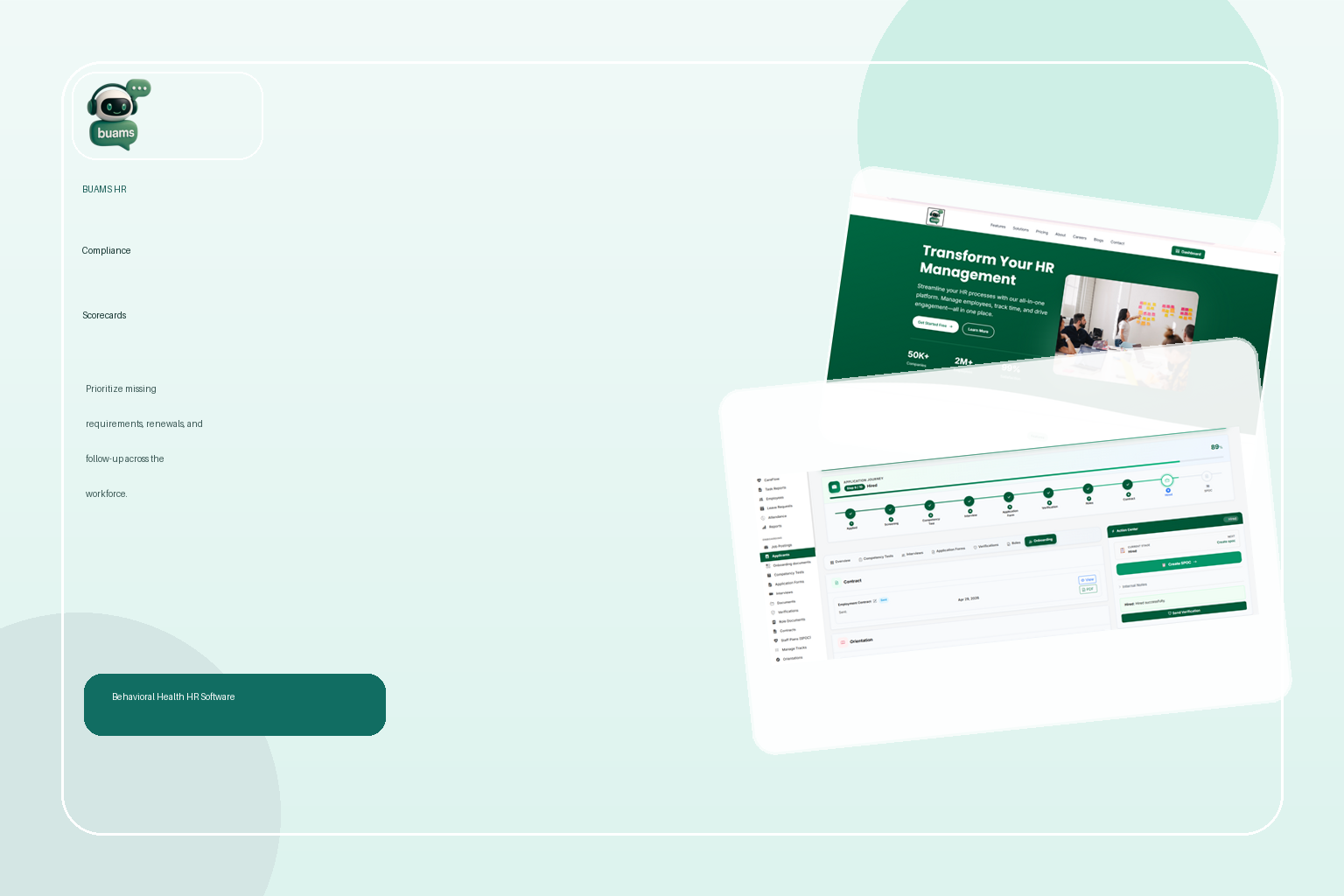
BUAMS HR can support employee compliance scorecards by keeping workforce records, HR documents, training status, and readiness signals connected in one place. That gives teams a stronger foundation for reviewing who is fully ready, who is approaching risk, and where follow-up effort should go first.
For behavioral health providers, that connection matters because compliance work is rarely isolated from staffing decisions. If a supervisor needs to review a missing item, if a credential is close to renewal, or if a file gap limits assignment options, HR needs that information to be visible in context. BUAMS HR helps reduce the back-and-forth between spreadsheets, file folders, and separate status trackers so leaders can make quicker and more consistent decisions.
Instead of treating compliance review as a periodic cleanup exercise, organizations can use a scorecard model to support day-to-day workforce management. That creates a better bridge between HR operations, program leaders, and compliance oversight.
Implementation Tips for a Better Scorecard Process
Final Thoughts
Employee compliance scorecard software helps behavioral health providers move from broad compliance visibility to practical prioritization. When HR teams can see which requirements are missing, which deadlines are approaching, and which programs are carrying the most workforce risk, they can act earlier and with more confidence. For organizations trying to protect readiness without drowning in manual follow-up, a scorecard approach offers a more disciplined and useful way to manage workforce compliance.