Behavioral health organizations depend on clear policies to support employee conduct, documentation standards, supervision expectations, confidentiality, safety procedures, and workplace consistency. But many HR teams still manage handbook updates through email attachments, shared folders, and paper acknowledgments that are hard to track later. When leaders cannot quickly confirm which version of a policy was issued, who signed it, and whether role-specific requirements were communicated, the organization takes on unnecessary compliance and employee-relations risk.
Employee handbook management software gives behavioral health providers a more reliable way to organize handbook content, distribute updates, collect acknowledgments, and maintain a clean audit trail. For organizations with multiple programs, locations, or job types, that structure matters because policy communication is not just an administrative task. It is part of workforce readiness, risk management, and operational discipline.
Key Takeaways
What Is Employee Handbook Management Software?
Employee handbook management software is a system used to manage policy documents, handbook versions, staff distribution, and acknowledgment records across the employee lifecycle. Instead of treating the handbook as a static PDF sent once at hire, the software helps HR teams maintain an active workflow for issuing new content, updating policies, confirming receipt, and preserving proof that each employee was informed.
In behavioral health settings, this matters because policy expectations often reach beyond generic HR rules. Staff may need clear guidance on documentation timeliness, clinical boundaries, incident reporting, attendance, training completion, supervision, workplace safety, confidentiality, and use of technology. A structured handbook process makes it easier to show that employees received the right information at the right time and that updates were handled consistently across the organization.
Why It Matters for Behavioral Health Providers
Behavioral health providers operate in environments where workforce communication can affect compliance, client safety, and service reliability. If one location receives a revised attendance policy while another continues using an outdated version, supervisors may apply standards inconsistently. If HR cannot prove which employees acknowledged a policy revision, the organization may struggle during an internal review, grievance, accreditation survey, or legal dispute.
Handbook management also becomes more complex as organizations grow. Multi-site providers often maintain different workflows for outpatient clinics, community programs, residential services, and administrative teams. Some policies apply across the entire workforce, while others are role-specific or site-specific. Without a centralized system, HR teams can lose track of which update belongs to which group and whether follow-up was completed.
A strong software-driven process reduces that confusion. It improves visibility into who has completed acknowledgments, which policies remain outstanding, and whether a supervisor needs to follow up with a team member before the issue becomes an avoidable risk.
Common Problems With Manual Handbook Workflows
Many organizations begin with simple methods such as emailed PDFs, shared drive folders, and signed paper receipts. Those methods can work for a small team, but they usually break down as the organization adds more staff, more locations, and more policy updates.
These gaps create practical problems, not just clerical ones. An incomplete policy record can slow employee investigations, weaken accountability conversations, and create uncertainty around what standard was communicated. For behavioral health providers, that uncertainty can affect both workforce management and broader organizational readiness.
What to Look For in Employee Handbook Management Software
The best employee handbook management software for behavioral health providers should support more than document storage. It should create a repeatable process for communication, acknowledgment, and record retention.
Version control and document history
HR teams need to know which version of a handbook or policy was active at a given time. The system should preserve prior versions, show effective dates, and make it easy to confirm which update was issued to which employee group.
Role-based and location-based distribution
Not every update applies to every employee. A useful platform should let HR assign policies by role, department, site, or program so staff only receive the content relevant to their responsibilities.
Acknowledgment tracking
The workflow should clearly show whether each employee received, reviewed, and acknowledged the document. That record should stay tied to the employee file rather than living in a disconnected folder.
Reminders and follow-up visibility
HR and supervisors should be able to see outstanding acknowledgments before they become a reporting problem. Automated reminders and clean status views help teams close gaps faster.
Secure storage and reporting
Handbook and policy records should be easy to retrieve during audits, investigations, and reviews, but access should still be controlled. A strong platform balances retrieval speed with appropriate confidentiality and record discipline.
Best Practices for Managing Handbook Updates
Software works best when the organization defines a clear process around it. Behavioral health HR teams should decide who approves handbook revisions, how effective dates are communicated, when employees must acknowledge updates, and what escalation path applies when acknowledgments remain incomplete.
It also helps to separate organization-wide handbook updates from targeted policy changes. For example, a revised confidentiality procedure for community-based staff may not need to go to every administrative employee. Segmenting updates keeps communication cleaner and makes reporting more meaningful.
Another important practice is linking handbook management to onboarding and supervisor accountability. New hires should receive the correct handbook version as part of their initial HR workflow, while existing employees should receive updates through a documented process that shows both communication and completion. Supervisors should have visibility into missing acknowledgments for their teams, but HR should still maintain the official record.
Finally, organizations should avoid treating policy acknowledgments as the only proof point. It is useful to maintain the signed record, but the larger goal is demonstrating a controlled process: approved content, correct distribution, tracked follow-up, and accessible documentation in the employee file.
How BUAMS HR Helps
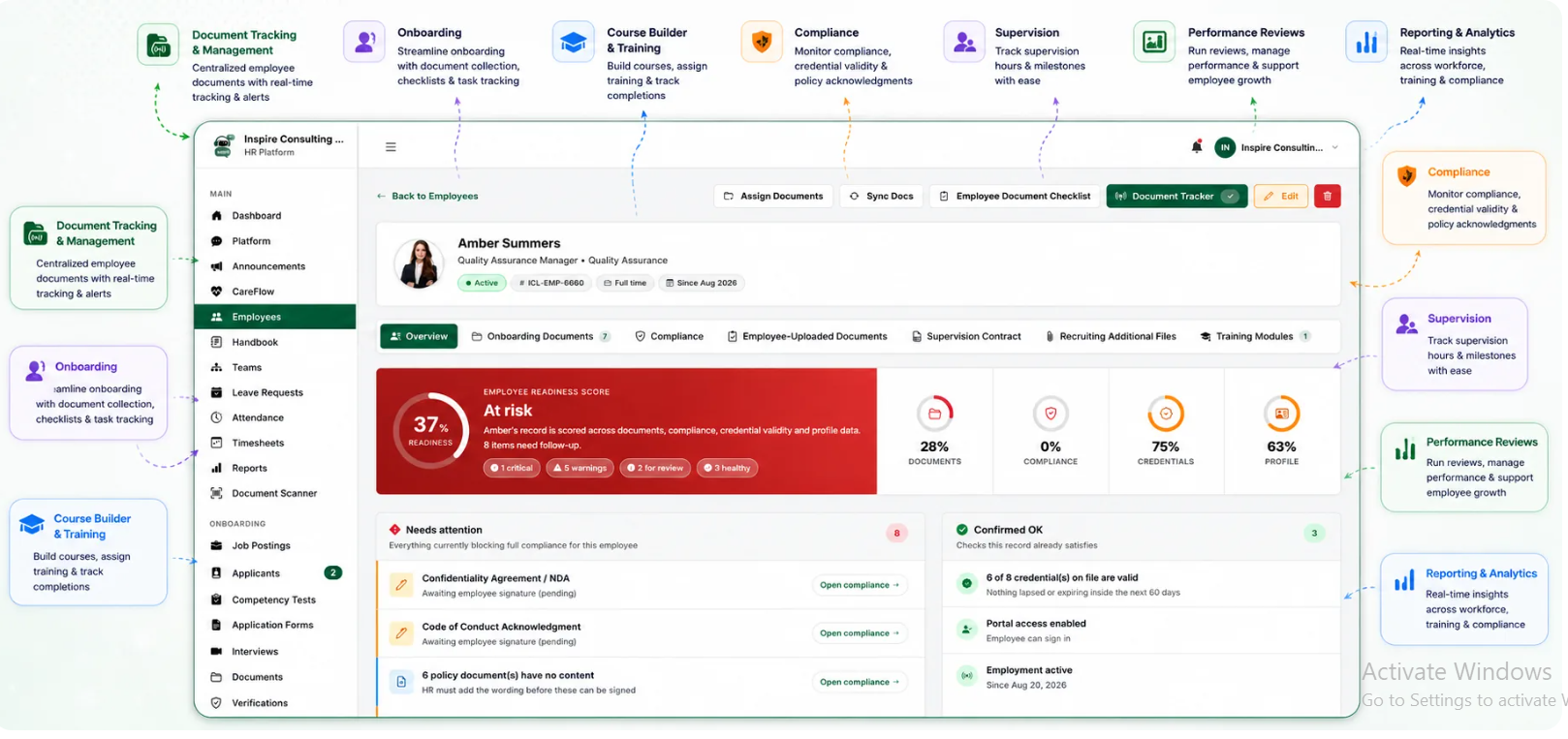
BUAMS HR helps behavioral health providers manage employee documentation in a centralized system built for real HR operations. Instead of keeping handbook records separate from onboarding packets, employee files, compliance items, and supervisor follow-up, organizations can keep critical workforce documentation connected in one structured environment.
That matters when handbook communication needs to support broader HR workflows. A policy acknowledgment may relate to onboarding readiness, a corrective action process, a role change, or a compliance review. With BUAMS HR, teams can organize those records together and reduce the fragmentation that often happens when documents live across email, spreadsheets, and shared drives.
For growing providers, BUAMS HR also improves visibility across programs and locations. HR leaders can maintain cleaner documentation, support more consistent distribution practices, and respond faster when leadership, auditors, or supervisors need proof that a handbook update was issued and acknowledged. The result is a more disciplined policy process without adding another disconnected tool to the stack.
Final Thoughts
Employee handbook management software helps behavioral health providers bring structure to one of the most overlooked parts of HR operations: proving that policies were distributed, acknowledged, and maintained correctly over time. When that process is managed well, organizations reduce confusion, strengthen accountability, and improve readiness for audits, investigations, and everyday workforce decisions.
For teams that have outgrown paper acknowledgments and email-based policy updates, BUAMS HR offers a practical way to centralize handbook records, connect them to employee files, and support a more reliable communication process across the organization.