Behavioral health providers depend on a workforce that is ready to serve clients safely, consistently, and without unnecessary administrative delays. That means HR teams cannot afford to manage employee immunization records through scattered spreadsheets, inbox threads, paper files, and last-minute follow-up. When vaccination documentation, boosters, declinations, and role-specific health requirements are stored in too many places, organizations lose time, miss deadlines, and create avoidable compliance risk.
Immunization tracking software gives behavioral health organizations a more reliable way to organize employee health records, monitor due dates, and respond quickly when an internal review, payer request, accreditation visit, or site audit requires proof. For providers operating across multiple programs, locations, or job types, a structured system is especially important because requirements often differ by role, exposure risk, and work setting.
Key Takeaways
What Is Immunization Tracking Software?
Immunization tracking software is a system used to record, organize, and monitor employee vaccination-related requirements. In a behavioral health setting, that can include proof of required immunizations, booster documentation, exemption or declination forms, due dates, renewal cycles, and notes tied to role readiness. Instead of treating this information as a one-time onboarding task, the software helps HR maintain it throughout the employee lifecycle.
For many providers, the real value is not just digital storage. It is visibility. HR leaders need to know which employees are fully cleared, which records are incomplete, what deadlines are approaching, and which locations or teams may be exposed to staffing disruption if documentation falls behind. A good system turns a reactive process into a managed workflow.
Why Immunization Tracking Matters in Behavioral Health
Behavioral health organizations often operate in environments where employee health documentation affects both compliance and service continuity. Staff may work in outpatient clinics, residential settings, community programs, schools, or integrated care environments. Different programs may have different expectations, and those expectations can change with contracts, policies, or public health guidance.
When immunization tracking is inconsistent, the consequences spread beyond HR. Start dates may be delayed. Supervisors may assume a staff member is cleared when documents are still missing. Compliance teams may have to scramble before an audit. Leaders may also struggle to identify whether the issue is isolated to one employee or part of a broader operational gap.
Accurate tracking supports several practical goals at once. It helps organizations protect client-facing operations, maintain complete employee files, reduce manual chasing, and respond with confidence when documentation must be reviewed. It also supports a fairer process because expectations, deadlines, and follow-up steps are easier to standardize across roles and programs.
Common Gaps in Manual Immunization Workflows
Many HR teams start with a spreadsheet and a shared drive because it feels simple. Over time, that setup becomes harder to trust. Records may be uploaded under different file names, renewal dates may be entered inconsistently, and no one is fully sure which version of a document is current. Even when the team is careful, the workflow depends heavily on memory and individual follow-up.
Some of the most common breakdowns include missing documentation at hire, incomplete files after transfers, unclear ownership for follow-up, and weak reporting for supervisors or compliance leads. In multi-site organizations, one location may be disciplined while another uses a different process entirely. That inconsistency makes organization-wide readiness harder to maintain.
What to Look For in Immunization Tracking Software
The best immunization tracking software for behavioral health providers should fit into a broader HR and compliance workflow. It should not force teams to build a separate recordkeeping system that creates more maintenance work. The goal is a repeatable process that supports readiness without adding friction.
Centralized employee record management
Immunization records should live in the same structured environment as onboarding documents, licenses, training records, acknowledgments, and other workforce compliance materials. That reduces duplication and makes the employee file easier to review.
Role-based requirement tracking
Not every employee needs the same documentation. Clinical staff, community-based employees, administrative workers, and supervisors may have different requirements depending on program design and risk exposure. A useful system should allow HR to assign and monitor requirements by role, site, or workflow.
Automated reminders and status visibility
Reminder workflows help the right people act before a deadline becomes a staffing problem. HR should be able to see which items are complete, pending, expiring soon, or overdue, and leadership should be able to review status without requesting a manual report every time.
Document proof and audit trail
Teams need more than a checkbox. They need the underlying document, the date it was received, and a clear record of updates or exceptions. That matters when questions come up months later about whether a file was complete at the time of hire or assignment.
Secure access and clean reporting
Employee health information should be handled carefully. Access controls matter, as does the ability to produce a clean report or organized file set when an internal review or external request arrives. Fast access is important, but controlled access is just as important.
Best Practices for a Stronger Process
Technology works best when the underlying process is clear. Behavioral health HR teams should define when documentation is required, who reviews it, where exceptions are stored, and what happens when a deadline is missed. A well-designed system supports those rules instead of leaving them to informal habits.
These practices help organizations shift from reactive document chasing to ongoing workforce readiness management. They also make it easier to train new HR staff because the process is documented and repeatable.
How BUAMS HR Helps Behavioral Health Organizations
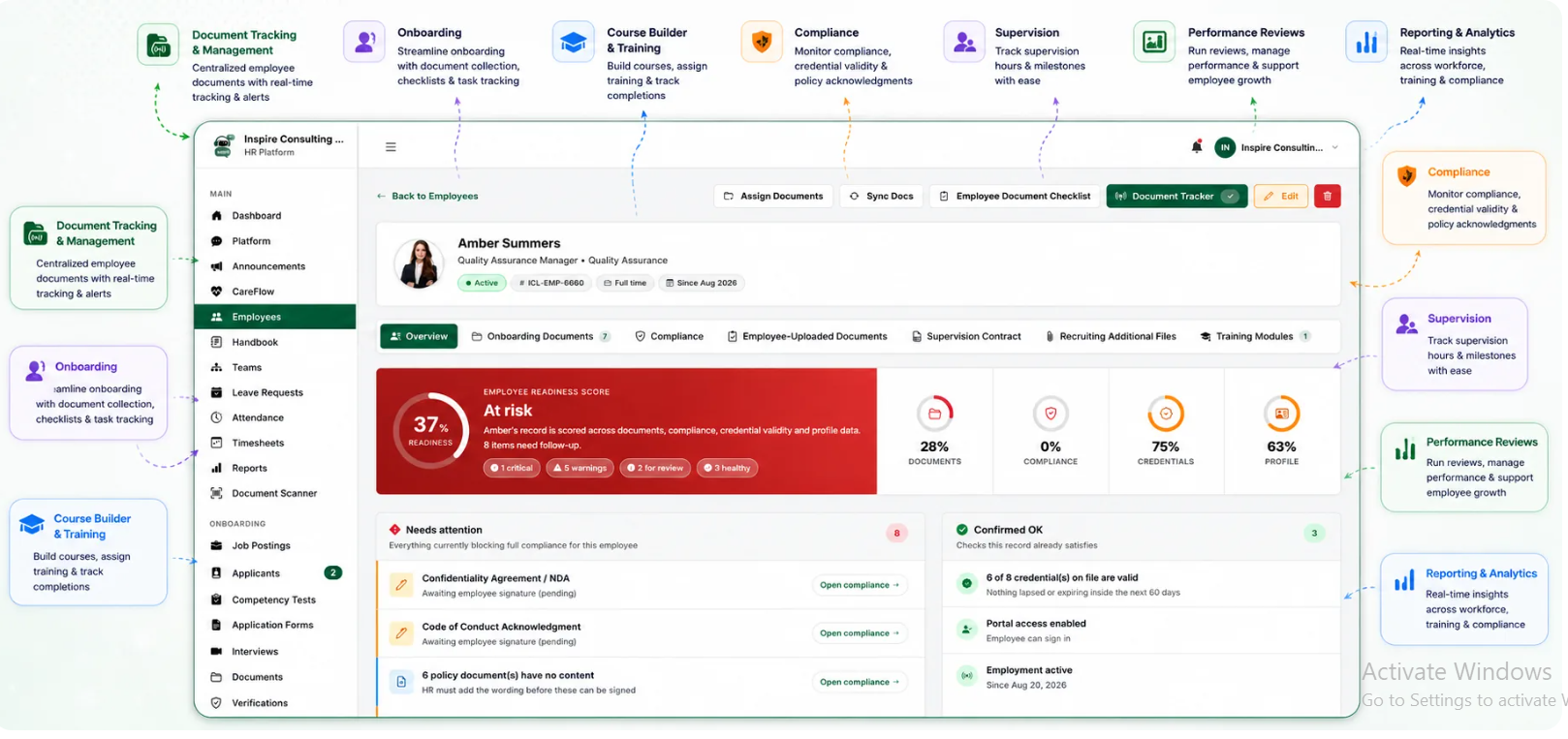
BUAMS HR gives behavioral health providers a practical way to manage employee readiness inside a broader HR operations system. Instead of keeping immunization records separate from hiring packets, employee files, training records, and compliance documentation, organizations can manage workforce information in one structured environment.
For HR teams, that means fewer handoffs and less time spent reconciling records across tools. For supervisors and compliance leaders, it means better visibility into staff readiness, missing items, and upcoming deadlines. For growing providers, it supports more consistency across programs and locations.
BUAMS HR is especially useful when immunization tracking needs to connect with onboarding and file completeness. If a new hire is waiting on required health documentation, the organization can treat that as part of an overall readiness workflow rather than an isolated spreadsheet task. That makes it easier to understand whether delays are happening at the document level, the supervisor review level, or the final clearance step.
Because the platform is designed for behavioral health organizations, the value is not just generic storage. It is the ability to support healthcare-oriented HR processes with better structure, visibility, and control.
Final Thoughts
Immunization tracking software helps behavioral health providers reduce avoidable risk and run a more dependable HR operation. When employee health documentation is centralized, monitored, and tied to real workflows, organizations can respond faster, keep files cleaner, and make staffing decisions with more confidence.
For providers that are still managing vaccine records manually, the biggest opportunity is not simply digitizing documents. It is creating a process that connects readiness, accountability, and compliance in one place. That is where a platform like BUAMS HR can make a meaningful difference.