Behavioral health providers often rely on required training to protect quality, safety, and compliance. But real operations are messy. A strong employee may be ready to start in a role before one course date opens up. A transferred supervisor may have equivalent training from another program. A new hire may need a temporary exception while a site-specific module is rescheduled. When those decisions are handled through side emails and verbal approvals, the organization can lose the record of why the exception was granted, who approved it, what temporary conditions applied, and when follow-up was due.
Training waiver approval software gives HR and compliance teams a structured way to review these requests without turning every exception into chaos. Instead of treating waivers as informal favors, providers can document the business reason, verify alternative evidence, route the request to the right approvers, and track the steps needed to close the gap. For behavioral health organizations that need flexibility without losing control, that structure matters.
Key Takeaways
What Is Training Waiver Approval Software?
Training waiver approval software is a workflow system used to review, approve, deny, and monitor requests to waive or temporarily defer required employee training. In behavioral health settings, that can apply to orientation modules, safety refreshers, role-specific learning, site-level onboarding tasks, annual education, or other workforce requirements that normally must be completed before full assignment readiness.
The point is not to weaken standards. The point is to manage exceptions deliberately. A provider may decide that prior documented learning satisfies part of a requirement, that an employee can work under temporary conditions until the next course date, or that a leader must review a case because operational needs and compliance expectations are in tension. Good software makes that reasoning visible and repeatable.
Why It Matters for Behavioral Health Providers
Behavioral health organizations operate in environments where training requirements are tied directly to service safety, documentation quality, supervision expectations, and workforce eligibility. If an exception is granted carelessly, the organization may assign someone before the person is fully prepared. If an exception is denied without a clear process, a needed hire or transfer may sit idle while teams struggle with coverage pressure.
The real problem is usually not the existence of exceptions. It is poor documentation around them. Many providers can explain in conversation why a waiver seemed reasonable, but they cannot easily prove what evidence was reviewed, whether the employee had temporary restrictions, or whether the missing training was ever completed later. That creates audit risk and internal confusion.
Training waiver approval software helps behavioral health providers balance operational reality with compliance discipline. It gives HR, supervisors, and program leaders one place to review the case, record the decision, and make sure the exception does not quietly remain open forever.
Common Breakdowns in Manual Waiver Processes
Without a defined system, waiver decisions are easy to lose track of. A manager may request an exception in email. HR may reply with conditions. Compliance may never be copied. The employee may begin work, and weeks later nobody is sure whether the requirement was fully satisfied or just postponed.
These gaps matter because they turn a manageable exception into a lingering compliance blind spot. In behavioral health, small workforce documentation failures can spread quickly across scheduling, supervision, and quality review processes.
What to Look For in Training Waiver Approval Software
Standard request intake
Every waiver request should begin with clear required fields. Teams should be able to record the missing training, the reason for the request, the employee role, the site or program involved, the requested duration, and any supporting evidence. That structure prevents vague exception requests that force HR to chase basic details.
Documented equivalency review
Some waiver decisions depend on whether prior learning or external documentation reasonably satisfies the requirement. The software should make it easy to attach proof, capture reviewer notes, and distinguish between a true waiver, a temporary deferment, and a substitution based on equivalent evidence.
Risk-based approval routing
Not every training gap carries the same level of risk. A low-impact administrative module may require one approver, while a clinical safety topic may need escalation to compliance or executive review. Good software supports routing rules that match the seriousness of the exception.
Temporary work conditions
If an employee is allowed to start or continue work before final training completion, the system should document any conditions clearly. That may include limited duties, extra supervision, restricted assignments, or a hard stop date. This protects both the employee and the organization.
Follow-up tracking and closure
The workflow should not end at approval. Strong training waiver approval software keeps the missing requirement visible until the training is completed, alternative evidence is accepted permanently, or the waiver is formally closed for another documented reason.
Reporting on exception patterns
Behavioral health providers should be able to see whether waiver requests are increasing in certain sites, programs, or training categories. Frequent exceptions may point to scheduling issues, poor onboarding planning, unclear policies, or a training capacity problem that needs a broader fix.
Best Practices for a Stronger Waiver Process
Software works best when leaders set clear operating rules behind it. Providers should define which trainings are never waivable, which can be temporarily deferred, what evidence counts as equivalency, and who has authority to approve different exception types.
That discipline helps organizations stay flexible without drifting into inconsistent exception handling across sites or managers.
How BUAMS HR Helps
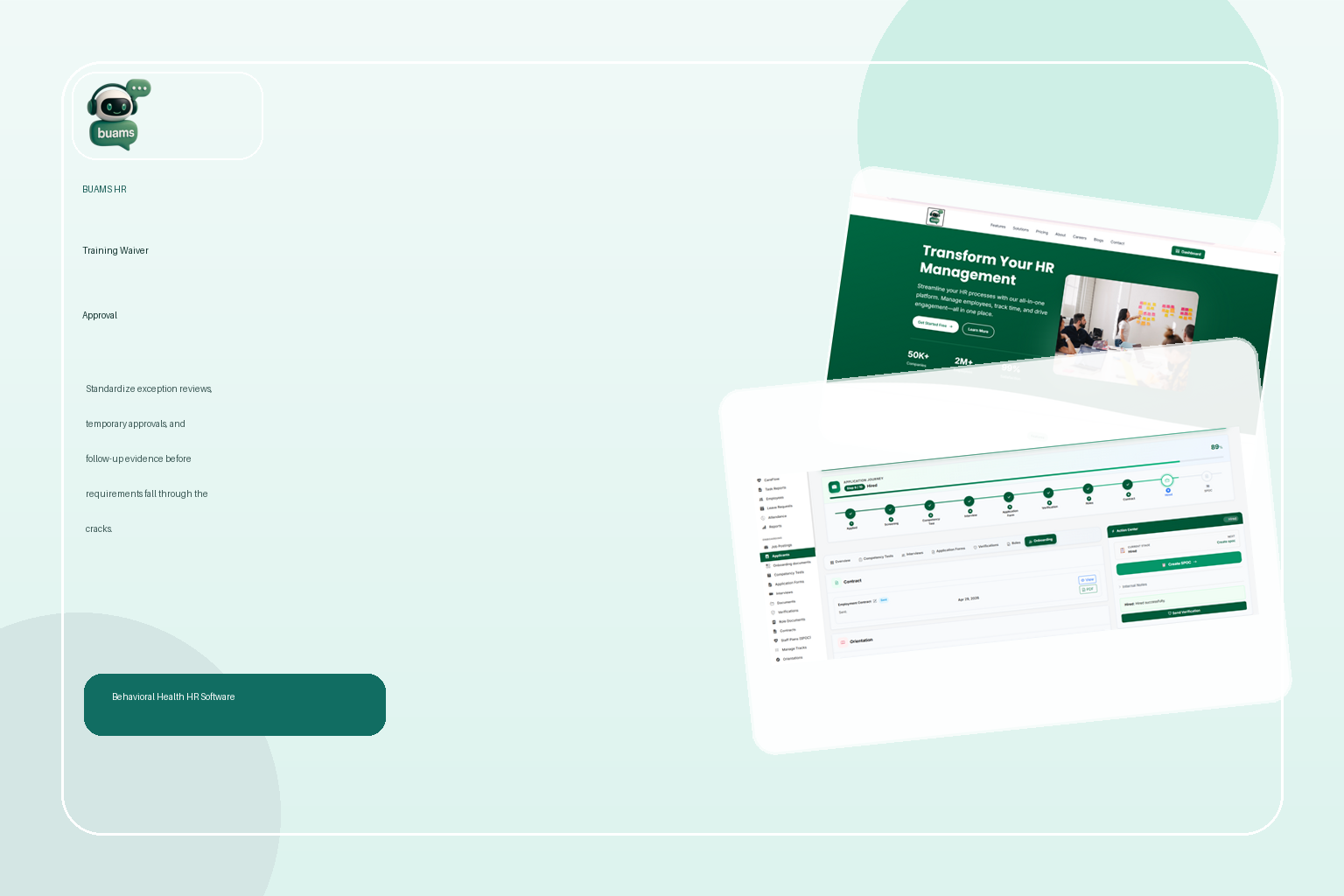
BUAMS HR gives behavioral health providers a practical foundation for managing training waivers inside a broader workforce record and compliance workflow. Instead of scattering exception details across inboxes, spreadsheets, and supervisor notes, teams can keep employee records, supporting documents, approval activity, and follow-up tasks more connected.
That matters when a waiver decision affects real staffing and supervision choices. HR can preserve the reason for the exception, program leaders can see what conditions apply, and compliance teams can confirm that the record remains visible until the requirement is resolved. For multi-site organizations, BUAMS HR also supports greater consistency by giving every team a cleaner framework for handling the same type of request.
When exception workflows are organized, providers do not have to choose between speed and control. They can move forward with clearer evidence, better accountability, and less risk that a temporary workaround turns into a permanent documentation gap.
Final Thoughts
Training waiver approval software helps behavioral health providers manage an uncomfortable but common reality: sometimes the organization needs a documented exception path without compromising compliance standards. The goal is not to create more waivers. The goal is to make every waiver visible, justified, and easy to close.
For HR and compliance teams trying to keep workforce readiness strong across changing programs and staffing pressure, that kind of structure is worth having. A disciplined waiver workflow reduces confusion, improves audit readiness, and helps leaders make better exception decisions when timing and training requirements collide.