Behavioral health providers often use tuition reimbursement to keep strong employees growing inside the organization instead of losing them to outside opportunities. The problem is that a valuable retention benefit can quickly become an administrative headache when requests, approvals, program rules, proof of completion, and repayment terms live across email threads, paper forms, and disconnected spreadsheets. A missed approval step can create budget friction. Missing grade documentation can weaken policy enforcement. Incomplete repayment tracking can leave HR and finance arguing about what was promised and what is owed.
Tuition reimbursement approval software gives behavioral health organizations a more reliable way to manage this benefit from request through payout. Instead of treating educational support as a side process, HR teams can build a structured workflow that protects budgets, applies policies consistently, and keeps employee records audit ready.
Key Takeaways
What Is Tuition Reimbursement Approval Software?
Tuition reimbursement approval software is a structured workflow for reviewing employee education requests, collecting supporting documents, routing approvals, and storing final records in one place. For behavioral health providers, that can include requests for counseling degrees, social work coursework, certificate programs, continuing education tied to advancement, or employer-supported role development for supervisors and direct care staff.
Instead of asking employees to email forms and wait for manual updates, the process can begin with a standard request that captures the course, institution, estimated cost, term dates, manager justification, and any agreement tied to continued employment. From there, the organization can route the request to the right approvers, set deadlines for required proof, and maintain a clean record of what was approved and what is still pending.
Why It Matters for Behavioral Health Providers
Retention pressure in behavioral health is real. Providers are competing for licensed clinicians, supervisors, support staff, and rising internal talent. Educational assistance can be a smart investment, but only if the process is fair, visible, and aligned with organizational priorities. When there is no standard system, employees may receive mixed answers, leaders may approve requests without budget context, and HR may struggle to prove whether policy requirements were met.
That risk is even higher in multi-program settings where staff work across outpatient, community-based, residential, or school-linked services. One department may require a manager sign-off, another may expect executive approval, and finance may not see the full list of pending commitments until reimbursement requests start arriving. A controlled workflow helps organizations avoid surprises while still offering a benefit that supports growth and retention.
Common Breakdowns in Manual Tuition Reimbursement Workflows
Many providers already offer some kind of education support, but the operating process behind it is often inconsistent. Requests may start in email, supporting documents may sit in personal folders, and no one owns the follow-up schedule once a course begins. That creates avoidable risk for HR and leadership.
These breakdowns do not just waste time. They make it harder to show that the benefit was administered consistently and according to policy.
What to Look for in Tuition Reimbursement Approval Software
Standardized request intake
Every request should start with the same required fields so HR is not guessing what information is missing. A clean intake step should capture program type, school name, course dates, cost, requested amount, employee role, and the business reason for support.
Clear approval routing
Behavioral health organizations often need more than one decision point. A strong workflow makes it easy to route requests to the direct supervisor, HR, and finance or executive leadership based on amount, department, or employee type. That reduces approval bottlenecks and keeps exceptions visible.
Document collection and due dates
Approval is only part of the process. Teams also need a reliable way to collect proof of enrollment, final grades, certificates, invoices, and signed agreements. Due dates should be visible so follow-up does not depend on memory.
Policy and repayment tracking
If the organization requires a minimum grade, a waiting period, or repayment after early departure, those conditions should be tied to the request record. This makes later enforcement more consistent and easier to explain.
Status visibility for employees and administrators
People should not need to chase updates through email. A good workflow lets HR and leadership quickly see which requests are pending approval, waiting on employee documents, approved for payout, or closed.
Employee file alignment
When the final request, approval trail, and completion proof are stored with the employee record, the organization preserves a better history of workforce development decisions and benefit administration.
Best Practices for a Stronger Reimbursement Process
Software helps, but the workflow still needs good policy design behind it. Providers usually get better results when they define a few practical rules up front and then enforce them consistently.
For behavioral health providers, the strongest programs connect education support to retention, supervision readiness, role advancement, and service capacity. That makes the benefit easier to justify and easier to manage.
How BUAMS HR Helps
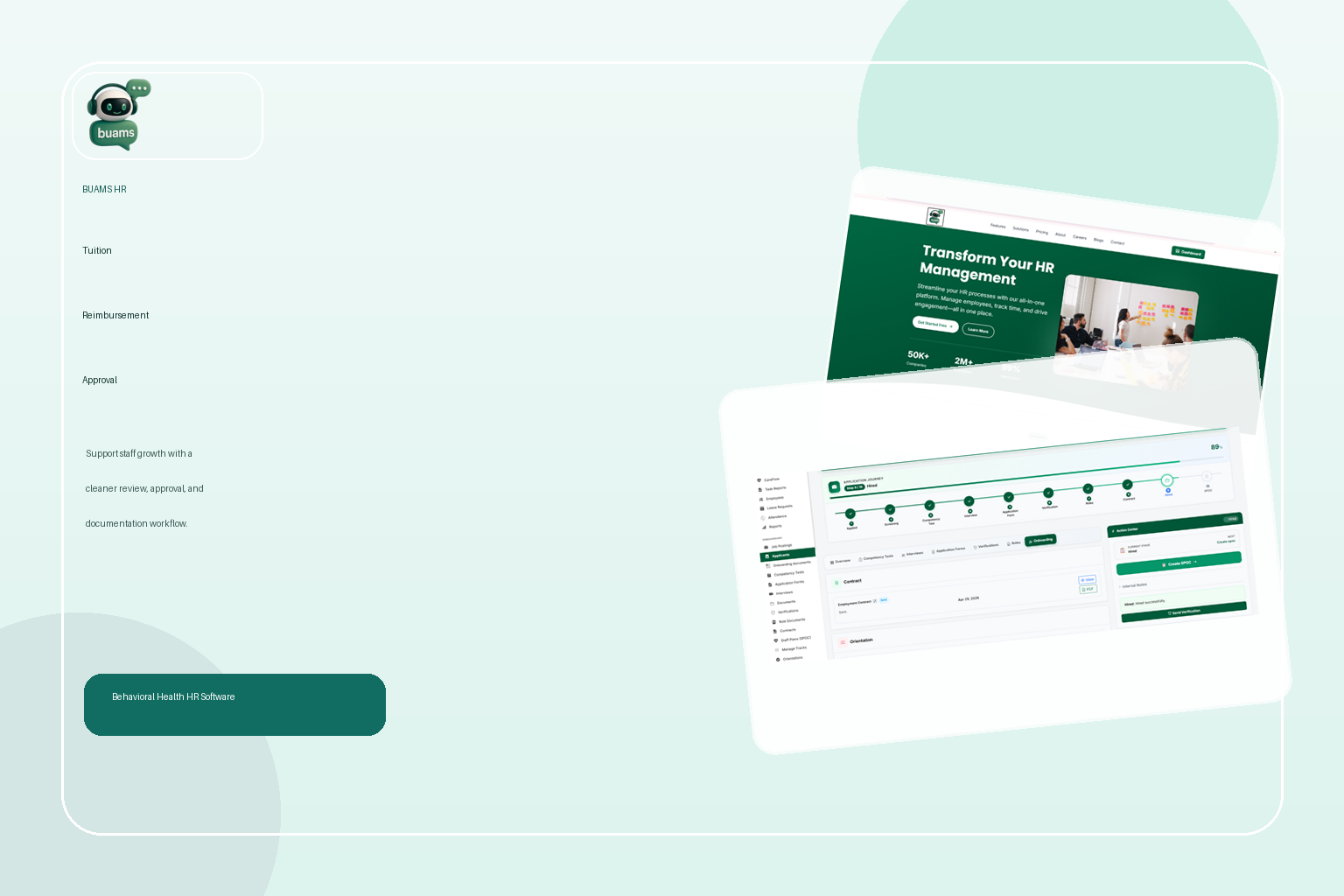
BUAMS HR gives behavioral health organizations a practical way to manage tuition reimbursement approvals inside a broader workforce and compliance environment. Teams can centralize employee requests, attach supporting documents, track approvals, and keep the final record connected to the employee file instead of leaving the process fragmented across inboxes and shared drives.
Because BUAMS HR is built for mental and behavioral health operations, it fits naturally alongside onboarding, credential tracking, supervision documentation, and workforce compliance workflows. That matters when education support is tied to promotion planning, licensure pathways, internal leadership development, or other readiness milestones that HR already manages.
With a more organized approval process, providers can support employee growth while maintaining clearer policy control, better recordkeeping, and fewer administrative delays.
Final Thoughts
Tuition reimbursement can be a powerful retention and development tool for behavioral health providers, but only when the administration behind it is disciplined. A manual process creates too many opportunities for inconsistent approvals, missing proof, and budget confusion. Tuition reimbursement approval software brings structure to a benefit that often matters deeply to employees and leaders alike.
For organizations that want to invest in staff growth without creating HR chaos, the right workflow is not just about paying for courses. It is about making sure every request, approval, document, and obligation is visible, consistent, and easy to manage from start to finish.