Behavioral health providers often rely on annual staff attestations to confirm that employees reviewed updated policies, acknowledged confidentiality expectations, completed required compliance steps, and understood role-specific responsibilities. The problem is that these sign-offs are frequently scattered across paper forms, email threads, shared drives, and supervisor follow-up notes. That makes it harder for HR teams to prove completion, identify missing acknowledgments, and respond quickly when an auditor or accreditation reviewer asks for evidence.
Annual staff attestation software gives providers a more controlled way to assign, collect, and track these recurring acknowledgments. Instead of chasing signatures one by one, HR can launch a consistent workflow, monitor completion by employee or program, and keep a clean record of what was signed, when it was signed, and which version of the document applied.
Key Takeaways
What annual staff attestations usually include
In behavioral health organizations, annual attestations can cover more than a simple handbook acknowledgment. Providers may need employees to confirm they reviewed confidentiality rules, workplace safety expectations, code of conduct updates, boundaries and ethics guidance, mandatory reporting responsibilities, supervision expectations, or role-specific procedures tied to the services they deliver.
Some agencies also require annual acknowledgments connected to credential maintenance, training completion, telehealth procedures, documentation standards, or updated workflows for programs in Maryland and DC. When these requirements are handled manually, it becomes difficult to keep the right version attached to the right employee record.
Why manual attestation tracking becomes a compliance risk
Manual processes usually break down in predictable ways. HR sends the forms, supervisors remind staff when they have time, and completed copies come back through different channels. A few employees sign late, a few sign the wrong version, and a few never make it back into the correct personnel file. By the time leadership wants a status update, HR is piecing together spreadsheets and email timestamps to figure out what is still missing.
That creates three practical problems. First, teams lose visibility into completion rates across departments, locations, or programs. Second, auditors may see inconsistent proof of who acknowledged what. Third, recurring annual tasks consume too much HR time because the process has to be rebuilt every cycle.
What to look for in annual staff attestation software
The best system should do more than store PDFs. Behavioral health HR teams need a workflow that supports assignment, completion tracking, reminders, document retention, and reporting. That starts with the ability to launch recurring attestations by role, program, location, or employee group so the right staff receive the right acknowledgment at the right time.
It also helps to have a clear status view showing which employees are complete, overdue, or still in progress. Supervisors and HR leaders should be able to see outstanding items without digging through email. For organizations that face regular audits or accreditation reviews, the software should also preserve date-stamped proof and keep the attestation linked to the employee's file.
How this supports behavioral health operations
Annual staff attestation software is especially useful in behavioral health because providers often manage multiple programs, service lines, and regulatory expectations at once. A single agency may need separate acknowledgments for outpatient teams, community-based staff, telehealth workflows, and supervisors. Without a centralized system, HR ends up running several parallel processes with inconsistent tracking.
With a standardized workflow, providers can schedule annual sign-off cycles, monitor progress by group, and escalate incomplete items before they become a larger issue. That improves readiness for external review while also reducing day-to-day administrative friction for HR teams that are already handling onboarding, employee files, credentials, and training oversight.
How BUAMS HR helps
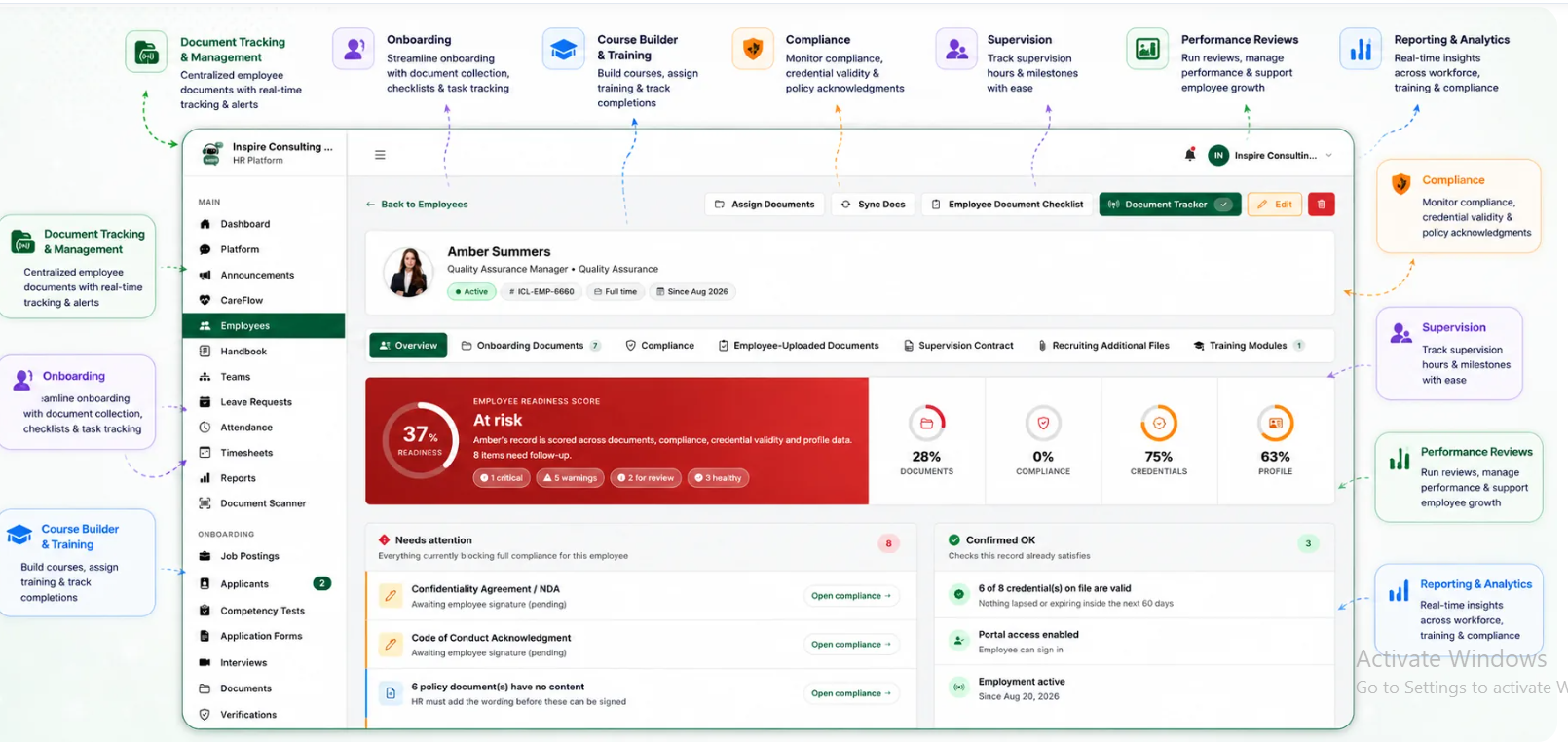
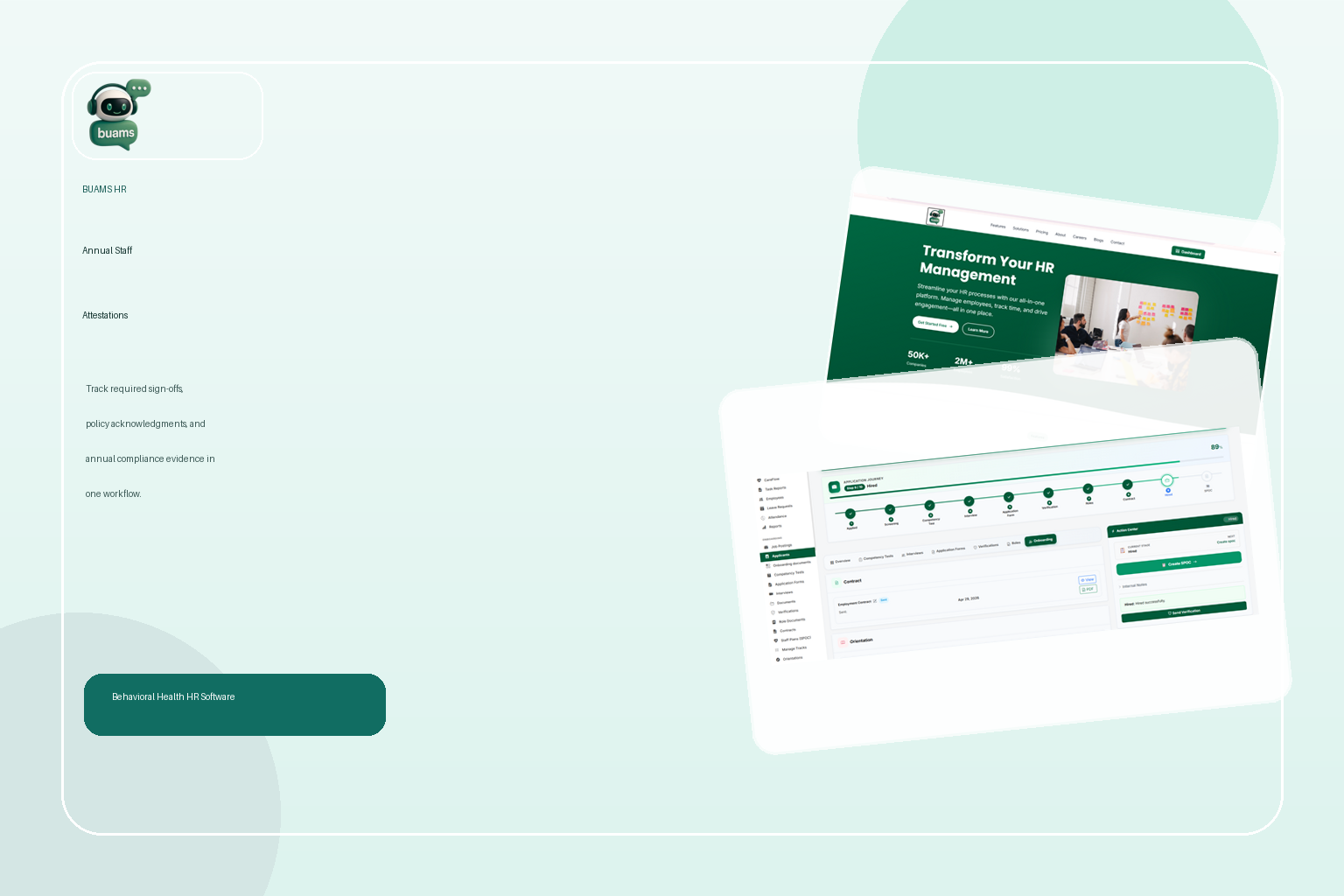
BUAMS HR gives behavioral health organizations a practical way to manage annual acknowledgment workflows inside a broader HR and compliance process. Instead of treating attestations as isolated documents, teams can connect them to employee records, role-based requirements, and follow-up activity across the workforce.
That means HR leaders can see which sign-offs are complete, which staff still need reminders, and where documentation gaps remain. Because records stay organized in one system, agencies can respond more confidently to leadership questions, internal audits, and accreditation requests without rebuilding the evidence trail from scratch.
For organizations trying to reduce manual tracking, annual staff attestation software works best when it is part of a larger operating system for employee records, compliance tasks, and workforce accountability. BUAMS HR supports that approach by helping providers standardize recurring workflows while keeping documentation accessible and review ready.
Final thoughts
If your team is still managing annual acknowledgments through paper packets, spreadsheets, or scattered email reminders, the process is probably taking more time than it should and leaving more risk than it needs to. Annual staff attestation software helps behavioral health providers turn a repetitive administrative task into a controlled, trackable workflow that supports both efficiency and compliance.
For growing agencies, the real benefit is not just collecting signatures. It is knowing that required sign-offs were assigned correctly, completed on time, and stored in a way that stands up to review.