Healthcare organizations manage a large amount of employee documentation. From professional licenses and certifications to background checks, insurance records, training documents, and signed policies, HR teams need to keep employee records organized and accessible.
For behavioral health organizations, employee document management can become even more complex because different employees may have different credentialing, training, supervision, and compliance requirements.
Managing these records through spreadsheets, email attachments, paper files, and separate folders can make it difficult to know whether an employee's documentation is complete and current.
A centralized healthcare employee document management system can help organizations organize these records and improve visibility into employee compliance.
What Is Healthcare Employee Document Management?
Healthcare employee document management is the process of collecting, organizing, storing, monitoring, and maintaining documents associated with employees.
These documents may include:
- Professional licenses
- Certifications
- CPR and BLS records
- Background checks
- Malpractice insurance
- Training certificates
- Employee agreements
- Policy acknowledgments
- Identification documents
- Employment records
- Clinical documentation
- Supervision-related records
The exact documents required depend on the employee's position, organization, location, and applicable requirements.
For behavioral health providers, having a structured system for these documents can make HR administration easier and provide better visibility into employee records.
Why Employee Document Management Matters in Behavioral Health
Behavioral health organizations may employ therapists, counselors, social workers, case managers, nurses, administrative staff, supervisors, and other professionals.
Each role can have different documentation requirements.
For example, a licensed clinician may need professional licensing documentation and certifications, while another employee may have a different set of required records.
When these documents are stored in multiple places, HR teams may spend significant time searching for files and determining whether information is still valid.
A centralized document management process can help HR teams quickly answer questions such as:
- Does this employee have all required documents?
- When does their license expire?
- Has their required certification been uploaded?
- Which employees have missing documents?
- Which credentials are approaching expiration?
- Are employee records ready for an internal review or audit?
Common Problems With Manual Employee Document Management
1. Documents Are Stored in Different Locations
An employee's records might be spread across email inboxes, Google Drive folders, desktop folders, paper files, and spreadsheets.
This makes it harder to maintain a single, reliable employee record.
2. Expiration Dates Are Easy to Miss
Many healthcare-related credentials and documents have expiration dates.
A document may be stored correctly but still become a problem if nobody notices that it has expired.
Manual spreadsheets require HR teams to regularly review dates and follow up with employees.
3. Missing Documents Create Extra Follow-Up
HR staff may have to send repeated emails asking employees to submit missing licenses, certificates, insurance documents, or other records.
When the organization has dozens or hundreds of employees, this follow-up can become a significant administrative task.
4. Growing Organizations Become Harder to Manage
A document management process that works for a small behavioral health practice may become difficult to maintain as the organization adds more employees and locations.
More employees mean more documents, more expiration dates, and more compliance requirements to monitor.
What Should Be Included in a Healthcare Employee Document
Management System?
A useful system should do more than simply store files.
Organizations should consider capabilities such as:
Centralized Employee Records
Each employee should have an organized record where relevant documents and information can be accessed without searching through multiple systems.
Document Categorization
Documents should be organized into logical categories so HR teams can quickly identify licenses, certifications, insurance records, training documentation, and other requirements.
Expiration Date Tracking
The system should allow organizations to record expiration dates for documents that need periodic renewal.
Automated Reminders
Automated reminders can help HR teams identify upcoming expirations before they become urgent.
Missing Document Tracking
HR teams should be able to identify which required documents have not yet been submitted.
Role-Based Requirements
Different employees may require different documents. A system should support requirements based on employee roles and organizational needs.
Reporting
Reports can provide a broader view of employee documentation and help HR teams identify outstanding requirements.
How Document Tracking Helps With Compliance
Employee document management and compliance management are closely connected.
Keeping a file organized does not automatically mean that an organization is compliant. HR teams also need to know whether required documents are present, valid, and up to date.
For example, an organization may have a clinician's professional license on file. However, if the license expires and the organization does not notice, the record is no longer current.
Document tracking can help by connecting each document with relevant information such as its expiration date and employee.
This gives HR teams a more proactive way to manage employee requirements rather than discovering problems after a document has already expired.*
Healthcare Employee Document Management vs. Spreadsheets
Spreadsheets are often used by small organizations to track employee documentation.
A typical spreadsheet might include:
| EmployeeDocumentExpiration DateStatus | |||
| Employee A | Professional License | Date | Active |
| Employee B | CPR Certification | Date | Expiring |
| Employee C | Insurance | Date | Active |
This can provide basic visibility, but spreadsheets have limitations.
They do not necessarily store the actual documents, and HR teams may still need to search through separate folders to find the files.
As the workforce grows, maintaining spreadsheets manually can also become increasingly time-consuming.
A dedicated employee document management system can bring document storage, tracking, expiration monitoring, and employee records into a centralized workflow.
How Behavioral Health Organizations Can Improve Document
Management
Organizations can establish a standardized document management process by following a few basic principles.
Create Standard Document Requirements
Define which documents are required for each employee role.
Keep Records in One Central Location
Avoid storing critical employee records across unrelated systems whenever possible.
Track Expiration Dates
Identify which documents require renewal and record their expiration dates.
Establish Reminder Workflows*
Set reminders early enough to give employees time to renew credentials and submit updated documentation.
Review Outstanding Requirements Regularly
HR teams should periodically review missing, expiring, and expired documentation.
Maintain Consistent Processes Across Locations
Organizations with multiple clinics should establish consistent document management procedures across their workforce.
How BUAMS HR Supports Employee Document Management
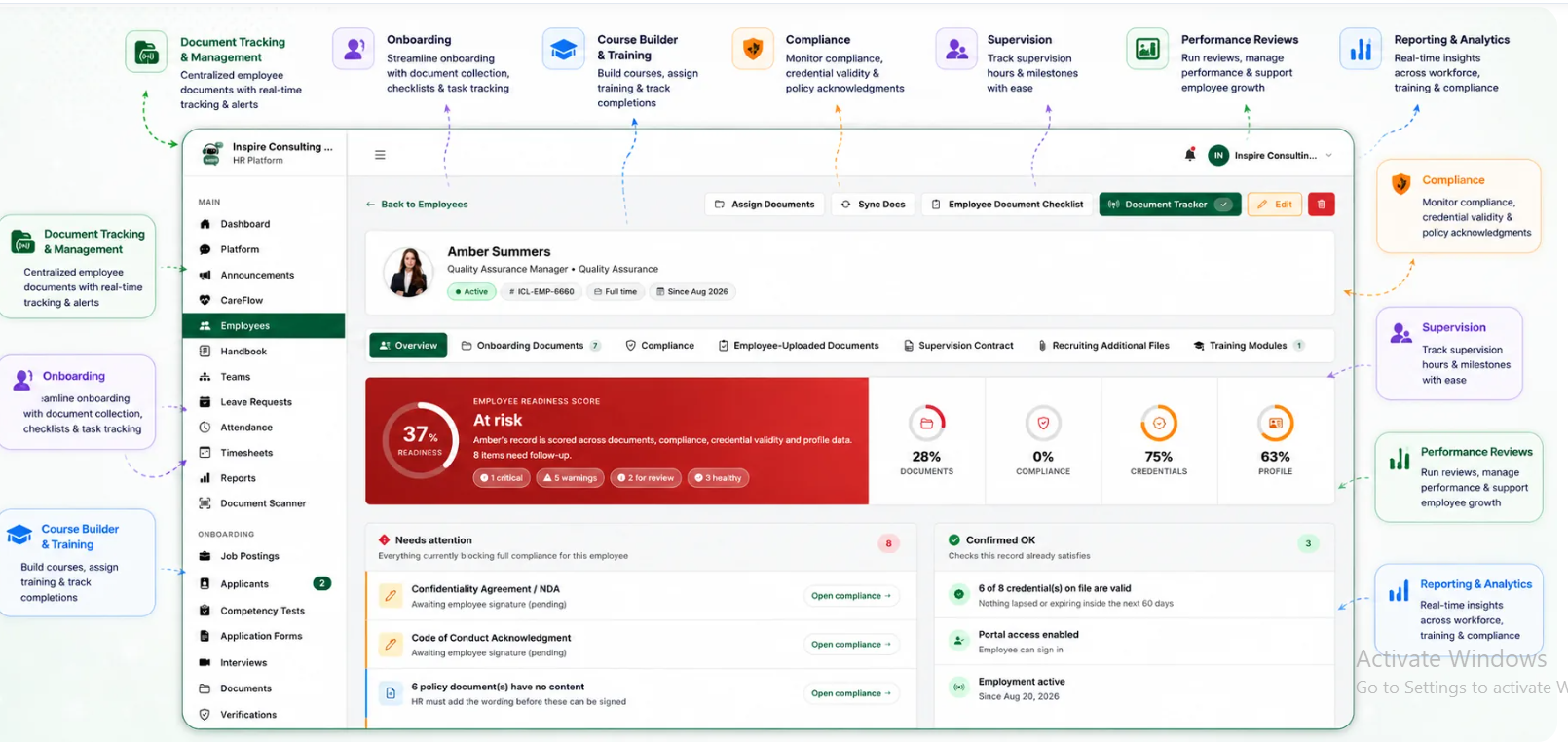
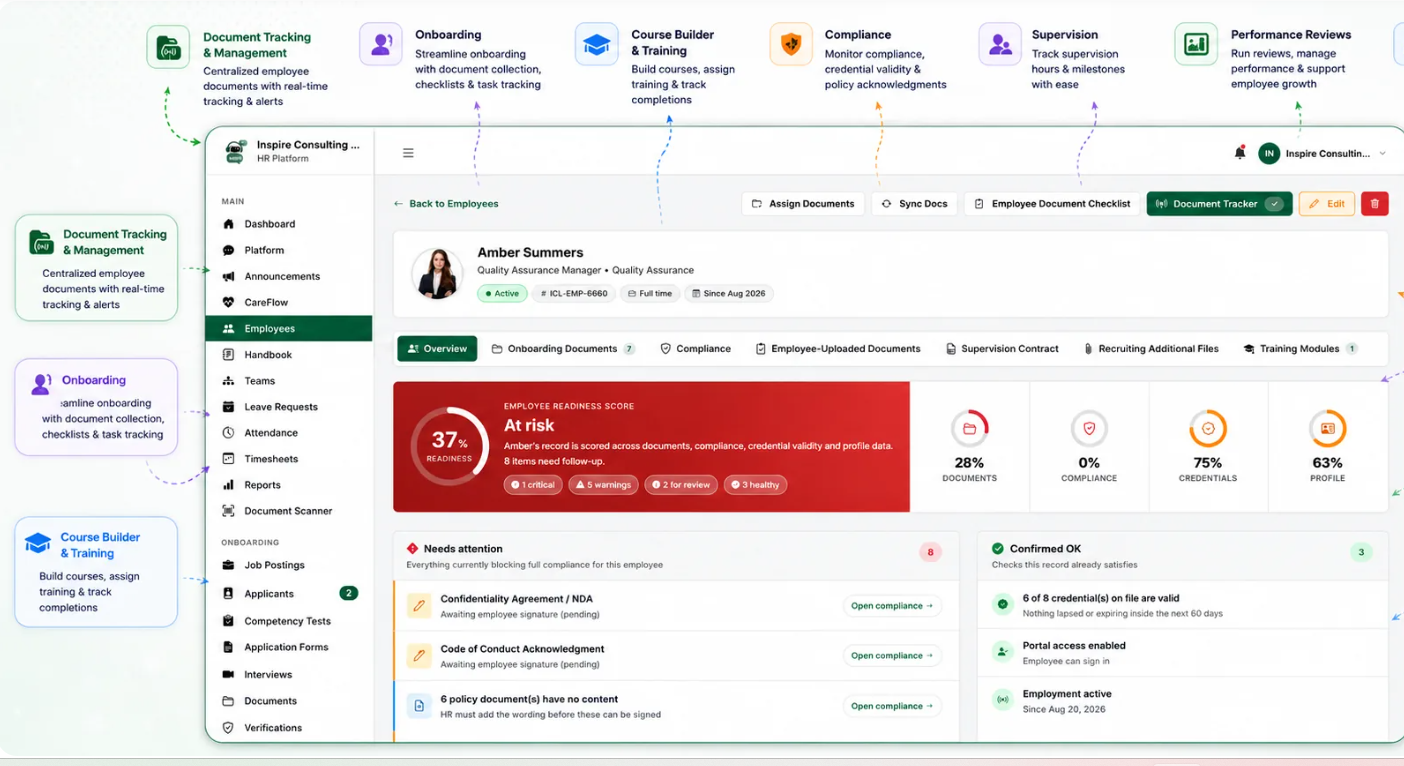
BUAMS HR provides a centralized platform designed for behavioral health organizations to manage employee information, documents, credentials, compliance, training, onboarding, clinical supervision, and other workforce processes.
Its document tracking capabilities allow organizations to keep employee documentation organized while monitoring important expiration dates and compliance requirements.
Instead of maintaining separate spreadsheets for employee documents and manually checking expiration dates, HR teams can use a centralized system to manage these requirements.
This approach can be particularly useful for behavioral health organizations managing multiple clinicians, employee roles, and locations.
Employee Document Management Checklist
A healthcare organization can use the following checklist when reviewing its employee document management process:
- Create a centralized employee record
- Define required documents by employee role
- Collect licenses and certifications
- Store employee documents securely
- Record expiration dates
- Monitor upcoming expirations
- Send renewal reminders
- Track missing documentation
- Review expired documents
- Maintain training records
- Keep policy acknowledgments organized
- Review employee records periodically
Final Thoughts
Healthcare employee document management is an important part of maintaining organized HR and compliance processes.
For behavioral health organizations, the challenge can become more complex because employees may have different credentials, certifications, training requirements, and documentation needs.
A centralized document management system can help organizations move away from scattered files and manually maintained spreadsheets toward a more structured approach.
BUAMS HR combines employee document management with credential tracking, compliance, onboarding, training, clinical supervision, and other HR functions, giving behavioral health organizations a centralized way to manage their workforce.
For organizations looking to reduce manual document tracking and improve visibility into employee requirements, specialized HR software can provide a more scalable approach to employee document management.