Behavioral health providers ask employees to work in offices, residential settings, community programs, crisis environments, and telehealth-supported operations that still rely on strong in-person safety practices. That means HR teams are often responsible for making sure OSHA-related training is assigned correctly, completed on time, documented clearly, and easy to prove during audits or internal reviews. OSHA training tracking software gives organizations a structured way to manage those responsibilities without depending on spreadsheets, shared drives, or last-minute reminder emails.
Key Takeaways
What Is OSHA Training Tracking Software?
OSHA training tracking software is a system for organizing safety training requirements, completion dates, renewal schedules, supporting proof, and follow-up actions in one place. For behavioral health providers, that can include training tied to workplace violence prevention, bloodborne pathogens, hazard communication, emergency response expectations, safe lifting practices, and other job-specific safety requirements that matter across clinical and administrative roles.
The goal is not just to show that a course was assigned. A useful process also shows who needed it, when it was completed, whether proof was uploaded, when retraining is due, and whether an employee should be limited from certain assignments until the requirement is finished. That visibility matters when organizations operate across multiple programs, sites, and shifts.
Why It Matters for Behavioral Health Providers
Behavioral health workforces face real operational risk when safety training is managed inconsistently. Staff may move between programs, take on community-based duties, return from leave, or transfer into higher-risk settings where the required learning profile changes. If HR and supervisors cannot quickly see whether OSHA-related training is current, organizations may expose employees to avoidable risk or discover documentation gaps only after an incident, complaint, or review.
The challenge grows when a provider has different role types, multiple locations, or a mix of direct care, nursing, administrative, maintenance, and support staff. A generic training spreadsheet often cannot show which requirements apply to which jobs, which deadlines are approaching, or which missing records could delay a start date or assignment. OSHA training tracking software helps teams turn scattered safety documentation into a repeatable workforce process.
What Behavioral Health Teams Need to Track
A strong OSHA training workflow should connect requirements to the actual work an employee performs. That means tracking more than a course title and a completion date. Teams usually need context that explains why the training applies, how often it must be repeated, and what evidence proves readiness.
When that information is centralized, HR teams can answer practical questions faster. They can confirm whether a new hire is ready for orientation, whether a transferred employee needs extra safety learning, or whether a supervisor should pause an assignment until missing documentation is resolved.
Common Failure Points Without a Centralized System
Many behavioral health organizations still manage OSHA-related training with a combination of email reminders, shared folders, and manually updated spreadsheets. That approach creates several avoidable problems. Deadlines get buried when ownership is split between HR, compliance, and department leaders. Completion proof may exist, but no one can find it quickly. Employees may complete training under one manager, then move to a different site where the record is not visible. Some teams also discover too late that a training standard changed and the old roster is no longer enough.
Another issue is weak reporting. Leadership may ask which staff are overdue, which programs carry the most safety-related training gaps, or which new hires are still missing required documentation. Without a clean system, those answers take too long to assemble. That delay can affect scheduling, site readiness, and confidence during audits.
What to Look for in OSHA Training Tracking Software
The best OSHA training tracking software for behavioral health providers should support real operational decisions, not just static recordkeeping. It should make safety readiness visible before small issues turn into staffing or compliance problems.
Role-based requirement mapping
Organizations should be able to assign different OSHA-related requirements by job, site, or program so employees only receive the training that matches their actual responsibilities.
Renewal alerts and dashboard visibility
HR and compliance teams need reminders for upcoming due dates, overdue completions, and missing proof. Clear dashboards help supervisors see which employees are fully ready and which ones need follow-up.
Documented completion proof
A strong system should store certificates, attendance records, signed acknowledgments, or internal validation notes in a way that is easy to retrieve during an audit, incident review, or policy check.
Connection to employee status changes
Training requirements should stay aligned when employees transfer locations, return from leave, change roles, or take on new duties. Otherwise, outdated assignments can create both noise and risk.
How BUAMS HR Helps
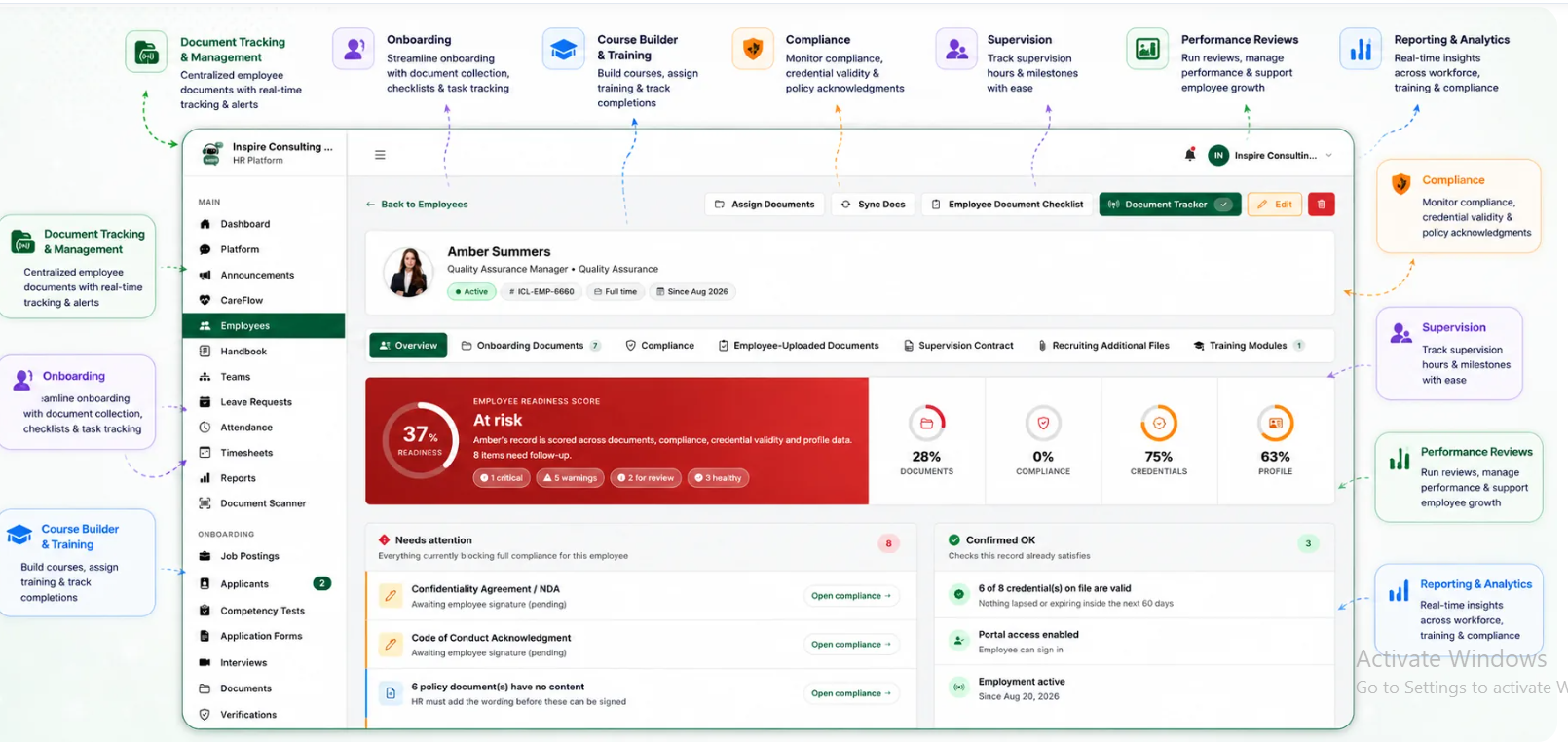
BUAMS HR helps behavioral health providers manage employee records, documentation workflows, and compliance visibility in one connected system. That gives HR teams a better foundation for tracking who has completed required safety steps, what proof is on file, and which employees still need follow-up before they are fully ready for a role or assignment.
Because BUAMS HR keeps workforce records organized across hiring, onboarding, document management, and ongoing compliance tasks, organizations can reduce manual chasing and create more consistent oversight. Supervisors gain clearer visibility into readiness, HR teams spend less time reconciling scattered files, and compliance leaders can respond faster when they need evidence tied to employee safety requirements.
Final Thoughts
Safety training is too important to manage with fragmented tools and memory-based follow-up. Behavioral health providers need a reliable way to connect OSHA-related learning requirements to employee roles, deadlines, proof, and assignment readiness. OSHA training tracking software gives HR and compliance teams that structure, helping them reduce risk while keeping operations moving.
For organizations that want safer workflows and stronger audit readiness, the most useful solution is one that keeps training records aligned with the rest of the employee lifecycle. That is how behavioral health teams stay prepared for growth, oversight, and the daily realities of workforce management.