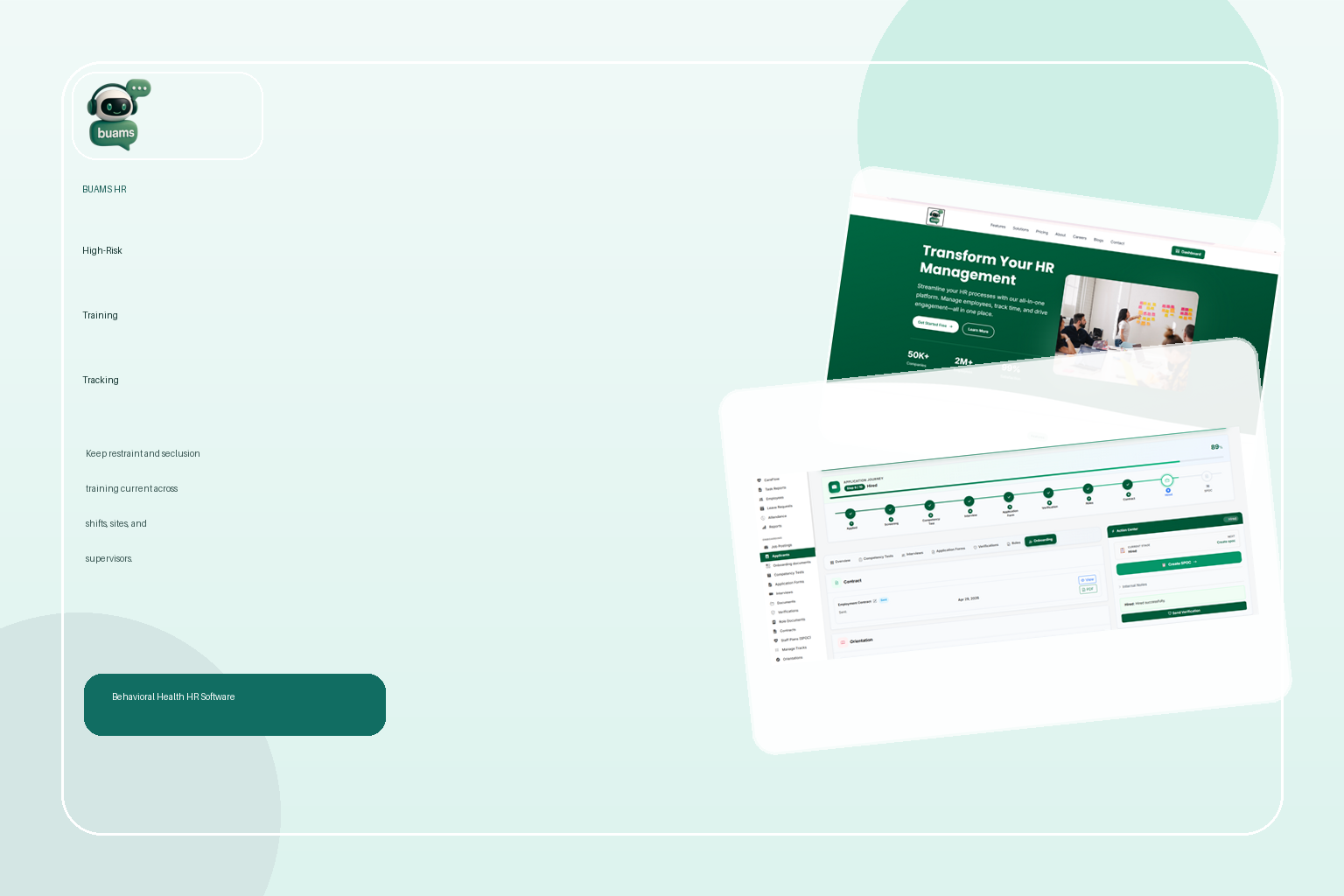
Behavioral health providers cannot afford uncertainty around high-risk staff training. When restraint and seclusion training records live across paper sign-in sheets, email attachments, and disconnected spreadsheets, HR teams may not know which employees completed the right course version, who needs renewal next, or whether a float staff member is fully cleared before covering a shift. That gap creates compliance risk, supervisory stress, and avoidable exposure when organizations need to prove workforce readiness quickly.
Restraint and seclusion training tracking software gives behavioral health organizations a more reliable way to manage course completion, renewal deadlines, role-based requirements, and supporting documentation in one workflow. Instead of scrambling before an audit or after a staffing incident, HR can monitor training status continuously and help program leaders act before missing requirements affect care delivery.
Key Takeaways
What Is Restraint and Seclusion Training Tracking Software?
Restraint and seclusion training tracking software is a workforce compliance tool that records who must complete high-risk intervention training, when they completed it, when retraining is due, and what proof is attached to the employee record. In behavioral health settings, that may include initial certification, annual refreshers, instructor-led sessions, competency sign-offs, incident-response refreshers, and program-specific policy acknowledgments.
The most useful systems do more than store a completion date. They connect the training requirement to the employee's role, site, supervisor, and current assignment so HR can see whether a staff member is eligible for specific duties right now. That context is what turns a training log into an operational decision tool.
Why It Matters for Behavioral Health Providers
Behavioral health organizations often run inpatient, residential, crisis, outpatient, and community-based programs with very different staff-readiness expectations. Some employees need full restraint and seclusion training, others need awareness-level instruction, and others may need site-specific refreshers based on program rules or state expectations. If those distinctions are not managed well, employees can be assigned work before training is current or supervisors can spend hours confirming readiness by hand.
This is also a documentation-heavy area. After a safety event, leadership may need to confirm whether involved staff were trained on time, whether competency validation was completed, and whether follow-up training was required afterward. A weak recordkeeping process makes those reviews slower and less reliable. A stronger tracking process helps teams respond with confidence and improves day-to-day workforce control before incidents happen.
Where Manual Tracking Breaks Down
What To Look For in Restraint and Seclusion Training Tracking Software
Role-based requirement mapping
Behavioral health providers need the ability to assign different training rules to different roles, programs, and sites. A one-size-fits-all requirement can create both compliance gaps and unnecessary work. The system should make it obvious who needs which level of training and why.
Renewal and expiration visibility
Training deadlines should be visible before they become urgent. Look for dashboards, upcoming expiration filters, and automated reminders that notify both HR and supervisors with enough time to schedule retraining without disrupting coverage.
Proof attached to the employee record
A completion date alone is not enough in a high-risk area. The software should let teams store certificates, rosters, competency sign-offs, and related documentation directly with the employee file so evidence is easy to retrieve during audits or incident reviews.
Exception handling for expired or incomplete training
When training lapses, organizations need more than a red flag. The workflow should support follow-up ownership, restricted assignment decisions, and documentation of corrective action so HR can show that overdue items were managed deliberately.
Reporting across sites and supervisors
Multi-site providers need a way to review readiness by program, location, manager, and role. That kind of reporting helps leadership spot patterns, such as one site falling behind on renewals or one supervisor carrying too many overdue staff items.
How BUAMS HR Helps
BUAMS HR supports a more organized approach to workforce compliance by keeping employee files, role information, and document tracking together in one system. For behavioral health providers, that creates a stronger foundation for tracking high-risk training requirements alongside other staff readiness records rather than managing them in isolated tools.
When HR can align training documentation with employee status, supervisor assignment, onboarding records, and related compliance items, it becomes easier to answer practical questions quickly. Is this employee cleared for the assignment? Which staff need retraining in the next 30 days? Which locations have the highest concentration of overdue items? Centralization helps teams move from reactive follow-up to ongoing visibility.
BUAMS HR also helps standardize documentation practices across programs. That matters when organizations are growing, covering multiple sites, or preparing for accreditation reviews where consistency matters as much as completion.
Practical Use Cases
Final Thoughts
Restraint and seclusion training tracking software helps behavioral health providers manage one of their most sensitive workforce compliance areas with more consistency and less guesswork. It strengthens visibility into renewals, improves documentation quality, and gives leadership better assurance that staff readiness decisions are based on current records instead of assumptions.
For organizations trying to protect safety, support supervisors, and stay ready for review, a structured training tracking workflow is more than administrative cleanup. It is a practical way to reduce risk while keeping workforce operations steady across shifts and sites.