Behavioral health organizations rarely struggle because they do not know their HR requirements exist. The real problem is that those requirements live in too many places at once. Hiring teams may use one checklist, supervisors may rely on another, compliance leaders may maintain a separate spreadsheet, and site managers may carry local exceptions in email threads. Over time, the same job can end up with different onboarding steps, different document requests, and different training expectations depending on who is handling the process. Role requirement mapping software helps behavioral health providers bring those rules together so each position follows a clearer, more consistent path.
For agencies managing licensed clinicians, direct-care staff, support roles, supervisors, and multi-site programs, that consistency matters. A role should trigger the right HR documents, policy acknowledgments, training assignments, supervision expectations, and readiness checks every time. When that mapping is weak, teams spend more time correcting preventable errors and less time moving staff into service safely. A structured system makes those expectations visible before gaps become delays or audit problems.
Key Takeaways
What Is Role Requirement Mapping Software?
Role requirement mapping software is a structured way to define what each position needs before an employee can be fully ready for work. Instead of storing job information as a title alone, the system links that role to the operational and compliance requirements that should follow it. Those requirements can include hiring documents, credential evidence, training assignments, acknowledgments, supervisor review steps, clearances, and recurring follow-up deadlines.
In behavioral health, that mapping is especially important because workforce requirements vary widely. A licensed therapist, peer recovery specialist, intake coordinator, residential counselor, and mobile crisis worker may all need different combinations of documentation and readiness steps. Even within the same organization, site-specific or program-specific rules may add another layer of complexity. A good mapping process keeps those differences organized without forcing HR teams to reinvent the checklist for every hire.
Why It Matters for Behavioral Health Providers
Behavioral health providers often operate in environments where staffing delays create immediate service strain. When a requirement is missed, the impact is not limited to paperwork. A start date may slip. A supervisor may have to scramble for coverage. A staff member may be scheduled before all expectations are complete. A compliance review may uncover inconsistent records across programs that were supposed to follow the same standards.
These issues tend to emerge when organizations manage role requirements informally. One recruiter may send a full packet while another uses an outdated checklist. A site manager may assume a training item belongs to all hires when it only applies to certain positions. HR may collect documents correctly but have no reliable way to confirm whether the role-specific workflow was actually complete. Role requirement mapping software reduces that ambiguity by defining the expected path up front and applying it consistently.
Common Problems When Requirements Are Not Mapped Clearly
Inconsistent onboarding by location or manager
When each team handles role setup a little differently, employees in the same position can experience different onboarding steps. That creates uneven file quality and makes it harder to prove that standards are applied consistently across the organization.
Missing role-specific documents or training
Some requirements only apply to certain jobs, which makes them easy to overlook if the process depends on memory. A direct-care role may need one set of acknowledgments while a supervisory role requires another. Without structured mapping, these details are often discovered late.
Workflow confusion after transfers or promotions
Role changes are a major weak point. If an employee moves to a new assignment and the organization only updates the title field, HR may miss the new requirements that should now apply. That can leave important approvals, files, or training steps unfinished.
Audit and review gaps
During internal review or accreditation preparation, agencies need to show that requirements are defined and followed consistently. If the logic behind those requirements lives in scattered documents and tribal knowledge, it becomes harder to demonstrate control.
What to Look for in Role Requirement Mapping Software
The most useful systems do more than list requirements in a spreadsheet. They help HR teams operationalize the rules so staff readiness can be managed in real workflows instead of one-off cleanup projects.
Best Practices for Building a Strong Requirement Map
Start with the roles that create the most operational risk
Organizations do not need to perfect every role at once. It is usually smarter to begin with high-volume or high-risk positions where missing requirements are most likely to cause service disruption, credential gaps, or delayed starts.
Separate core requirements from local variations
Most behavioral health roles have a stable set of core expectations, even when programs add local details. Defining the universal requirements first helps prevent unnecessary process duplication and makes local exceptions easier to manage.
Review the workflow whenever a role changes
Adding a new position or renaming an existing one should trigger more than a title update. HR should review whether document requests, training rules, supervisory steps, and compliance timelines need to change with the role.
Use one source of truth
If the approved requirement map lives in one place but staff continue using older checklists elsewhere, inconsistency returns quickly. The strongest process gives HR, supervisors, and operations teams a shared source of truth for what each job requires.
How BUAMS HR Helps
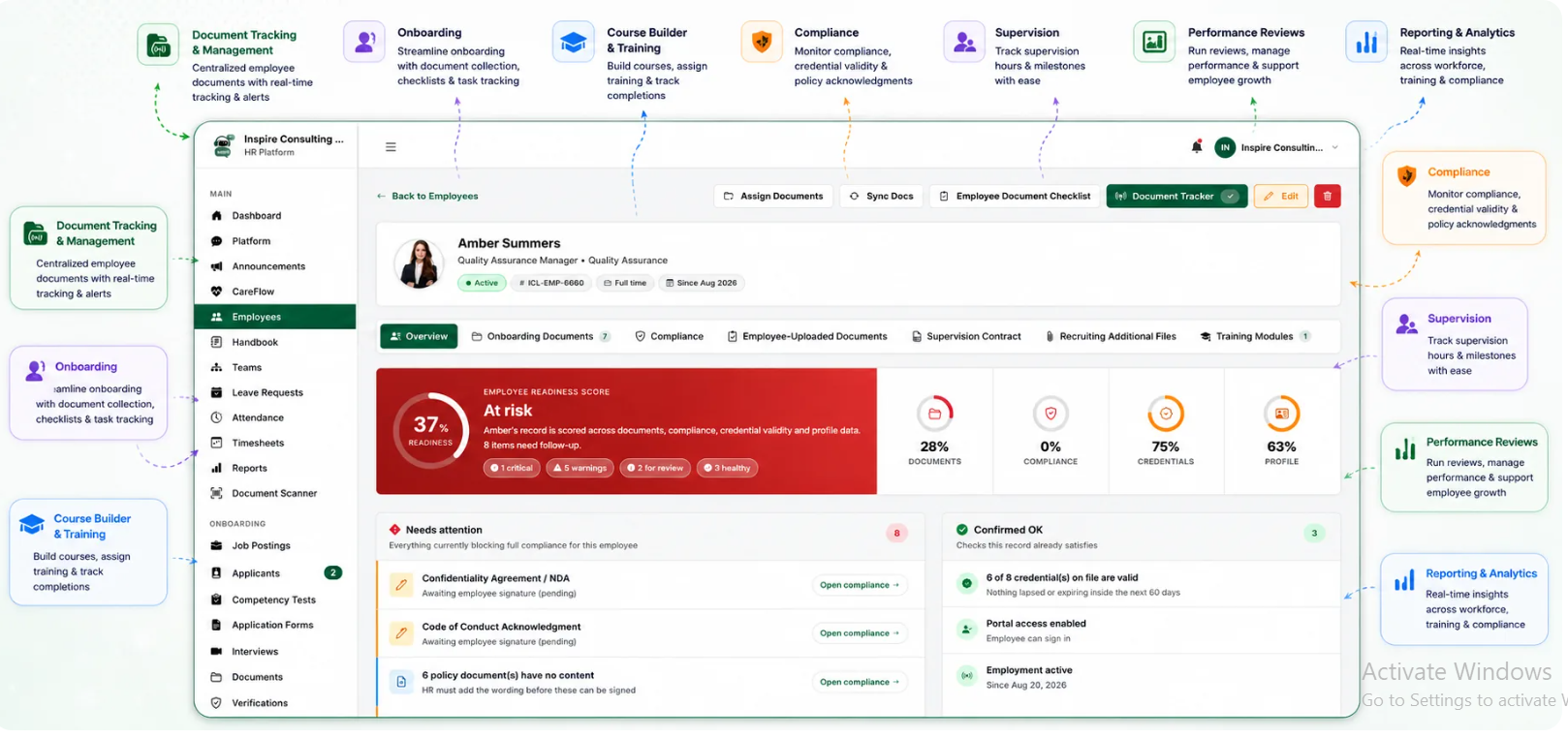
BUAMS HR helps behavioral health organizations manage workforce requirements with more structure and less manual chasing. By centralizing employee files, document workflows, and compliance-related records, BUAMS HR gives teams a more reliable foundation for connecting role expectations to the employee record. That makes it easier to standardize how hiring packets, acknowledgments, clearances, and recurring requirements are handled across programs.
For providers juggling multiple sites and job types, BUAMS HR supports consistency without forcing HR teams to rebuild the process each time a role is filled. Teams can organize requirements more clearly, see which items are still outstanding, and preserve better documentation of what was requested, received, and approved. When a staff member changes roles, the organization is better positioned to evaluate what needs to be added, updated, or reviewed instead of relying on memory.
Final Thoughts
Role requirement mapping software gives behavioral health providers a better way to turn scattered HR expectations into a repeatable system. When each job is linked to the right documents, training, approvals, and follow-up rules, organizations reduce preventable delays and strengthen their compliance posture at the same time.
For growing providers, consistency is not a nice-to-have. It is what keeps workforce operations scalable as programs expand and responsibilities become more complex. BUAMS HR helps make that consistency practical by bringing employee records and role-based workflow management into one organized process.