Behavioral health providers often hire across multiple programs, credentials, and role types, which means standard training requirements do not always arrive in one perfectly uniform package. One candidate may complete an approved orientation through a prior employer. Another may present equivalent CEU documentation. A supervisor may sign off that a staff member met a role requirement through an alternate pathway, but the proof sits in email instead of the employee file. When HR cannot clearly document why a requirement was accepted, those exceptions create friction during onboarding and raise questions later during audits.
Training equivalency tracking software gives behavioral health organizations a more structured way to manage that problem. Instead of treating every exception as a one-off judgment call, HR teams can document what requirement was involved, what alternate proof was submitted, who reviewed it, what decision was made, and what follow-up is still required. That helps organizations move hiring forward without losing the evidence and consistency needed for compliance.
Key Takeaways
What Is Training Equivalency Tracking Software?
Training equivalency tracking software is a system used to review and document cases where a staff member meets a requirement through alternate evidence rather than the organization’s default training path. In behavioral health, that might include outside certificates, prior employer orientation records, professional education, internal competency demonstrations, or approved program-specific substitutions.
The purpose is not to waive standards casually. The purpose is to create a defensible review process. HR teams need a reliable way to connect the required training item to the submitted proof, capture who reviewed the request, store supporting documents, and record whether the staff member is fully cleared, partially cleared, or still needs additional training. Without that structure, the organization may move forward on verbal approvals that cannot be reconstructed later.
Why Equivalency Decisions Matter in Behavioral Health HR
Behavioral health providers work in environments where role readiness affects service quality, supervision, assignment safety, and compliance posture. Teams may be hiring clinicians, support staff, residential workers, peers, interns, supervisors, and administrative employees across different sites. Many of those roles carry onboarding, policy, or competency requirements that look similar on paper but vary in application across programs.
That creates regular pressure to evaluate alternate proof. A new hire may already have de-escalation training, trauma-informed care coursework, CPR documentation, privacy training, or credential-related education that appears comparable to an internal requirement. If HR rejects everything by default, start dates slow down and managers get frustrated. If HR accepts everything informally, the organization creates audit exposure. Training equivalency tracking software helps providers handle those situations with more discipline.
It is especially useful when an agency is growing quickly, operating in multiple jurisdictions, or trying to standardize onboarding across decentralized teams. In those settings, the risk is not only a wrong decision. The risk is inconsistent decision-making, where one location accepts documentation another location would reject, and no one can explain the difference later.
Where Manual Equivalency Review Usually Breaks Down
These breakdowns are common because equivalency decisions sit between speed and control. Managers want staffing gaps filled quickly. HR wants complete documentation. Compliance teams want defensible evidence. Without a shared workflow, the organization ends up with approvals that may have made operational sense at the time but are hard to prove afterward.
What to Look For in Training Equivalency Tracking Software
Requirement-level documentation
The system should show exactly which training or readiness requirement is under review. That sounds simple, but it matters. If a staff member presents alternate proof, HR needs to connect that proof to a specific obligation instead of saving a certificate in a generic folder and hoping the context is obvious later.
Evidence collection and storage
Equivalency review only works when supporting documentation is easy to attach and retrieve. The software should make it simple to store certificates, transcripts, course outlines, supervisor attestations, or internal review notes alongside the request. Behavioral health providers should not have to search email threads to explain why a decision was made.
Structured approval workflow
Not every equivalency decision should be owned by the same person. Some may require HR review, while others need clinical leadership, compliance, or program management involvement. A strong workflow makes ownership clear so requests do not stall or get approved without the right reviewer.
Status visibility
Teams need to know whether a request is pending, approved, denied, or approved with conditions. In many organizations, the biggest operational problem is ambiguity. A manager assumes a new hire is cleared. HR assumes additional training is still required. Status visibility reduces that confusion before the staff member is scheduled or assigned in error.
Audit-ready decision history
The organization should be able to show when the request was submitted, what proof was reviewed, who made the decision, and whether any follow-up training remained open. That history matters for internal accountability and for external reviews where the agency needs to demonstrate a repeatable process rather than isolated judgment calls.
Best Practices for a Stronger Equivalency Process
Start by defining which training requirements are eligible for equivalency review and which are not. Some organizations create unnecessary chaos by treating every requirement as negotiable. Others do the opposite and force staff through duplicate training even when strong proof already exists. A better approach is to set practical rules around what can be reviewed, what evidence counts, and who has authority to approve.
It also helps to separate full equivalency from temporary clearance. In some cases, a staff member may be allowed to begin limited duties while final proof is reviewed or while a short add-on module is completed. That distinction should be visible in the record so managers know exactly what has been approved and what still needs action.
These practices help behavioral health providers balance operational flexibility with compliance discipline. They also reduce repeat work because HR does not have to re-evaluate the same missing context every time a file is reviewed.
How BUAMS HR Helps
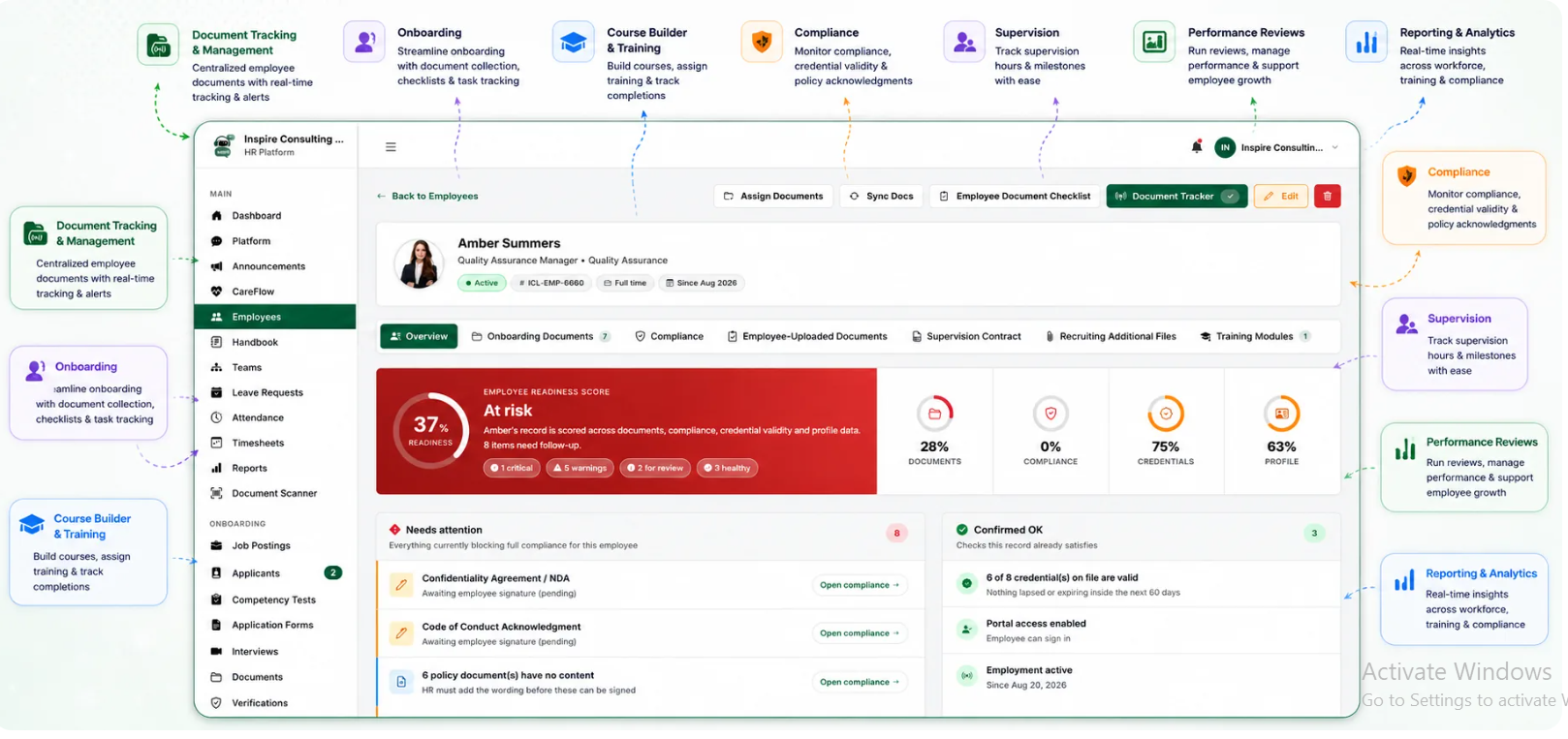
BUAMS HR helps behavioral health providers organize employee records, onboarding tasks, compliance documents, and workforce follow-up in one system. That kind of structure is especially useful for training equivalency tracking software because equivalency decisions are only trustworthy when they stay connected to the employee’s broader HR record.
With BUAMS HR, organizations can centralize supporting documents, maintain clearer status visibility around readiness items, and reduce the reliance on inboxes and side conversations when exceptions need review. That makes it easier for HR, supervisors, and compliance leaders to see what proof has been submitted, what remains outstanding, and whether a staff member is fully cleared for the role.
For growing behavioral health agencies, BUAMS HR also supports more consistent decision-making across sites and programs. Instead of each team inventing its own exception process, providers can build a repeatable workflow for documenting alternate training proof, preserving approvals, and preparing cleaner files for internal or external review.
Final Thoughts
Training equivalency tracking software gives behavioral health providers a practical way to review alternate proof without turning every exception into a compliance gamble. When equivalency decisions are documented well, organizations can move faster on hiring and onboarding while still protecting audit readiness and role clarity.
For providers managing multiple training requirements across a diverse workforce, the goal is not just speed. The goal is consistent, defensible workforce readiness. With a structured process and a centralized platform like BUAMS HR, teams can accept valid alternate proof without losing control of the record behind the decision.